
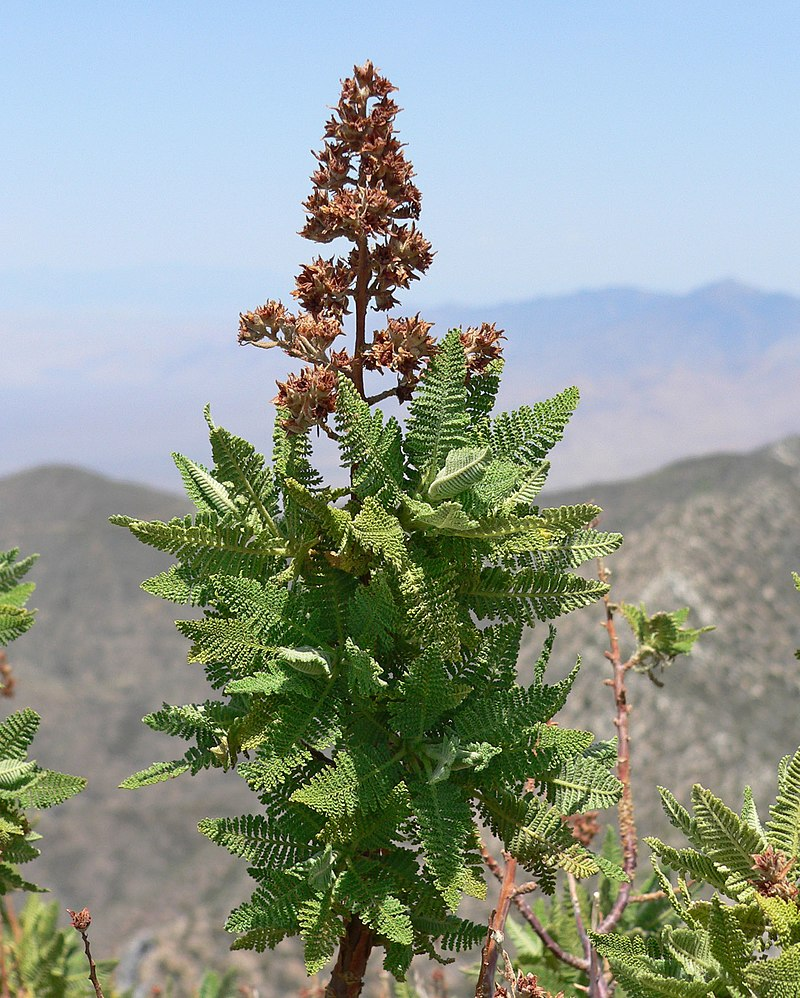
Also known as desert sweet, this sweetly-aromatic semi-deciduous shrub is native to western US from Oregon to California, east to Idaho, Utah, and Arizona where it grows in scrub, woodland, and forests. It is a member of the rose family, Rosaceae, that also includes cherry, almond, and lady’s mantle. The multi-stemmed plants grow 6-8′ tall and have erect downy stems that are sticky when young. The fern-like leaves are 3/4-3″ long and bipinnately compound into very small leaflets. The leaflets are light green above, pale below, sticky, and lobed or have wavy margins. In mid summer, 4″ long terminal panicles of white 5-petaled, .4″ wide flowers appear and give way to brown seed capsules that persist into winter. Plants may become invasive but are useful in xeriscapes because of their extreme drought tolerance. The genus name, Chamaebatiavia, refers to its resemblance to plants of the genus Chamaebatia (mountain misery) endemic to California, but not related to Chamaebatiavia. The specific epithet, millefolium, comes from the Latin words mille meaning thousand and folium meaning leaf, and refers to the foliage.
Type: Flowering semi-deciduous shrub
Outstanding Feature: Flowers
Form: Rounded
Growth Rate: Moderate
Bloom: Panicles of small white flowers in mid summer
Size: 6-8′ H x 6-8′ W
Light: Full sun
Soil: Average, dry, well-drained
Hardiness: Zones 6-10
Care: Low maintenance
Pests and Diseases: None of significance
Propagation: Cuttings, seeds
Photo Credit: Stan-Shebs,Wikimedia-Commons.