
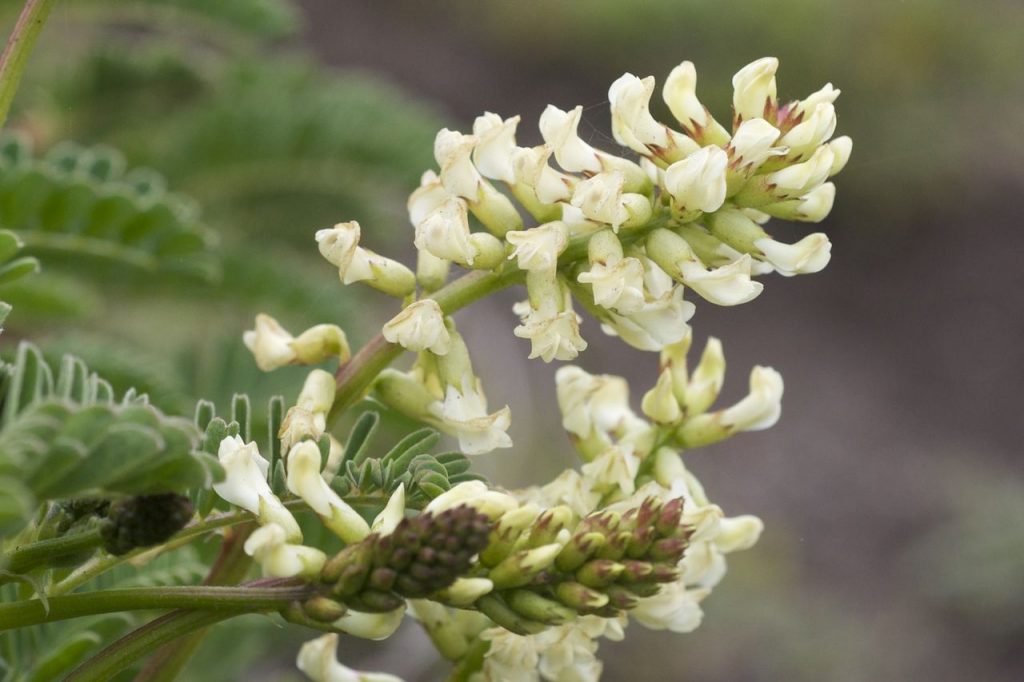
Native to bluffs, dunes, and rocky outcrops of coastal areas of California and Baja California, this herbaceous perennial is a member of the pea family, Fabaceae, that also includes lupines, mimosa, and black locust. Plants grow 8-40″ tall and have tangled hairy to hairless stems. The pinnately divided leaves are 6″ long and have 21-45 oval to oblong leaflets. Throughout the year, large clusters of 20-125 white to pale cream colored flowers appear sometimes tinted with pale purple. The flowers are about 1/2″ long, point downwards, and give way to an inflated seed pod that is 1-2″ long, inflated, and bears many seeds. Plants are sometimes grown as a ground cover. The genus name, Astragalus, is the Greek name for a leguminous plant. The specific epithet, nuttallii, honors Thomas Nuttall ( 1786 – 1859), an English botanist and zoologist who lived and worked in America from 1808 to 1841.
Type: Herbaceous perennial
Bloom: Clusters of white to pale cream colored flowers sometimes tinted with pale purple, throughout the year
Size: 8-40″
Light: Full sun
Soil: Sandy, dry to medium moist, well-drained; salt tolerant
Hardiness: Zones 9-11
Care: Low maintenance
Pests and Diseases: None of significance
Propagation: Seed
Companion Plants: Sand verbena, saltbush, beach evening primrose
Selections:
var. nuttallii ( leaflets with longer, greyish hairs on the top surface; endemic to the Central Coast of California)
var. virgatus (no such hairs; more widespread)
Photo Credit: Eric in SF Wikipedia