
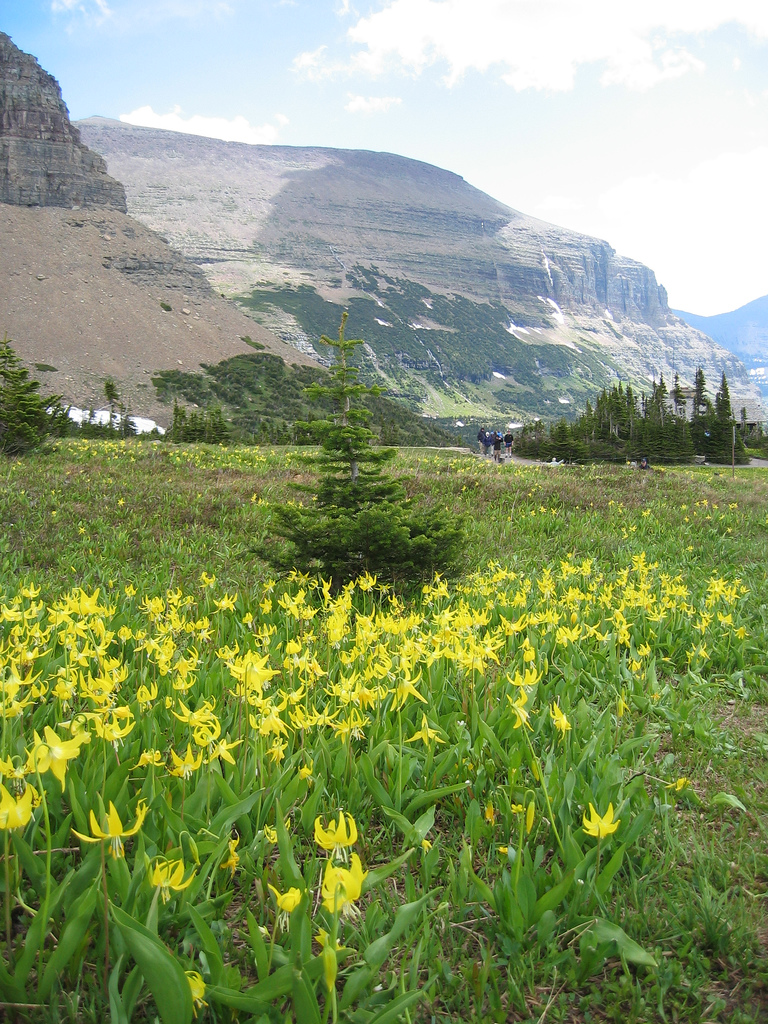
Also known as dog’s-tooth violet or adder’s tongue, the genus Erythronium includes 20-30 species and is in the lily family, Liliaceae, that also includes tulip, fritillary, and toad lily. They are perennials and all but six of the established species are native to North America where they grow in forests and meadows. Flowering plants have a pair of green leaves while vegetative plants have only one leaf. The leaves may or may not be mottled with brown, purple or white depending on the species. The bell-shaped flowers are usually nodding, may be single or in clusters of 2-5, and open only during the day. There are usually 6 tepals that may be ascending, spreading or recurved and white or yellow in color with tints or markings of pink to blue or purple . Anthers are conspicuous and may be white, yellow, pinkish, reddish, or brown. Some species are difficult to distinguish and the same common name may be used for more than one species. Plants usually like some shade and humus-rich, well-drained soil.
The genus name Erythronium comes from the ancient Greek ἐρυθρός (eruthrós) meaning red, and refers to the flower color of the type species, E. dens-canis.
Photo Credit: Wikipedia
The environmental conditions of the Rocky Mountain area have resulted in at least 1 native species of fawnlily there but it is native to other places too. The fawn lily described here is native to five of the states in the Rocky Mountain area.
Yellow Avalanche Lily (Erythronium grandiflorum)
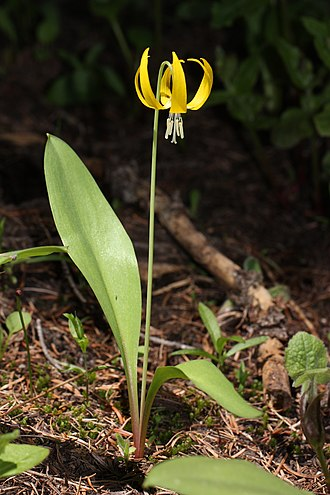
A basal pair of solid green leaves are fleshy, broadly lance-shaped, and up to 14″ long. Leafless stalks bear one to three nodding flowers with recurved, bright lemon-colored tepals surrounding white stamens tipped with white, red, or yellow anthers. A variety with white tepals is also possible. Flowers are pollinated by hummingbirds and bees including bumble bees.
Alternate Name/s: Glacier lily, snow lily, fawn lily, dogtooth fawn lily, large-flowered adder’s tongue
Native Range: Idaho, Montana, Wyoming, Colorado, and Utah as well as in places in the Pacific Coast and Southwest
Habitat: Subalpine mountain meadows, slopes, and clearings
Type: Perennial
Height: 8-12″
Bloom Time: Late spring-early summer
Bloom Color: Yellow
Light: Part sun
Soil: Humusy, consistently moist, well-drained
USDA Hardiness Zones: 3-9
Photo Credit: Wikipedia
Six states are included in the Rocky Mountains area: Montana, Wyoming, Idaho, Colorado, Utah, and Nevada. The geography is diverse and includes mountains, plains, and deserts, and the climatic conditions are variable and vary with the geography. Low annual rainfall and high temperatures are typical of some parts of the area, while snowfall and low temperatures are found in other parts and the mountains of all of these states.
 Karen
Karen