
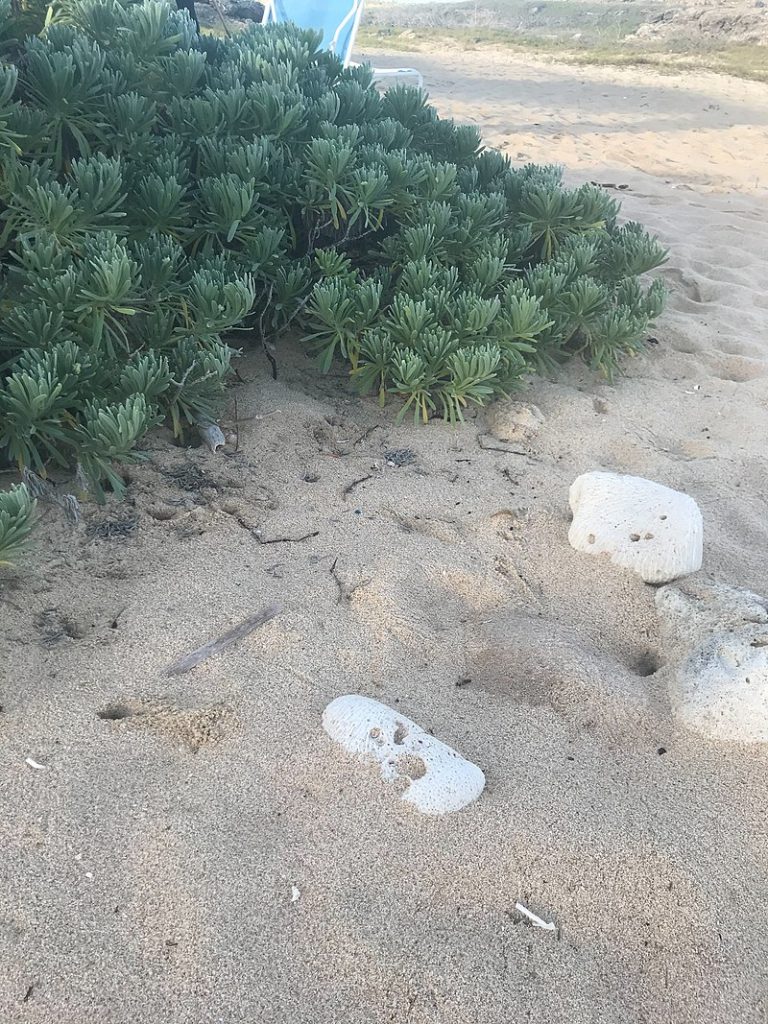
Also known as sea rosemary, bay lavender, and iodine bush, this evergreen shrub is native to coastal areas of southern and central Florida. It is a member of the borage family, Boraginaceae, that also includes forget-me-not, lungwort, and bugloss. The shrub has low growing, spreading, yellowish green, softly hairy stems that form mounds 3-6′ tall with thick, linear to spatulate leaves. The leaves are 2-5″ long, covered with fine gray hairs, and grow in dense terminal tufts. The 5-lobed flowers are carried on one-sided coiled spikes all year around but with a peak from fall to winter. They may be white, pink or lavender, with a greenish, yellowish or pinkish throat, and are attractive to butterflies. The fruit is an ovoid drupe with a corky interior that aids in ocean seed dispersal. Sea lavender is valued for dune stabilization, in a container, and as a specimen, hedge, or screen. It is a good choice for native plant, butterfly, or seaside gardens. The genus name, Heliotropium, comes from the Greek words Ἥλιος (helios) meaning sun, and τρέπειν (trepein) meaning to turn and refers to the belief that the plant turns its flowers toward the sun. The specific epithet, gnaphalodes, may be from the Greek φυλλώδης (phullṓdēs, meaning resembling a leaf.
Type: Evergreen shrub
Outstanding Features: Foliage, flowers, hurricane resistance
Form: Mound
Growth Rate: Rapid when young, more slowly with maturity
Bloom: Five-lobed, fragrant,white, pink or lavender flowers with a greenish, yellowish or pinkish throat year round but with a peak in fall and winter
Size: 3-6′ H x 3-10′ W
Light: Full sun
Soil: Sandy, dry to slightly moist, well-drained; tolerant of salt spray and occasional/brief inundation
Hardiness: Zones 9-10
Care: Low maintenance
Pests and Diseases: Healthy in coastal environment but susceptible to disease inland
Propagation: Seed, layering, cuttings
Photo Credit: Caribiana Wikimedia