
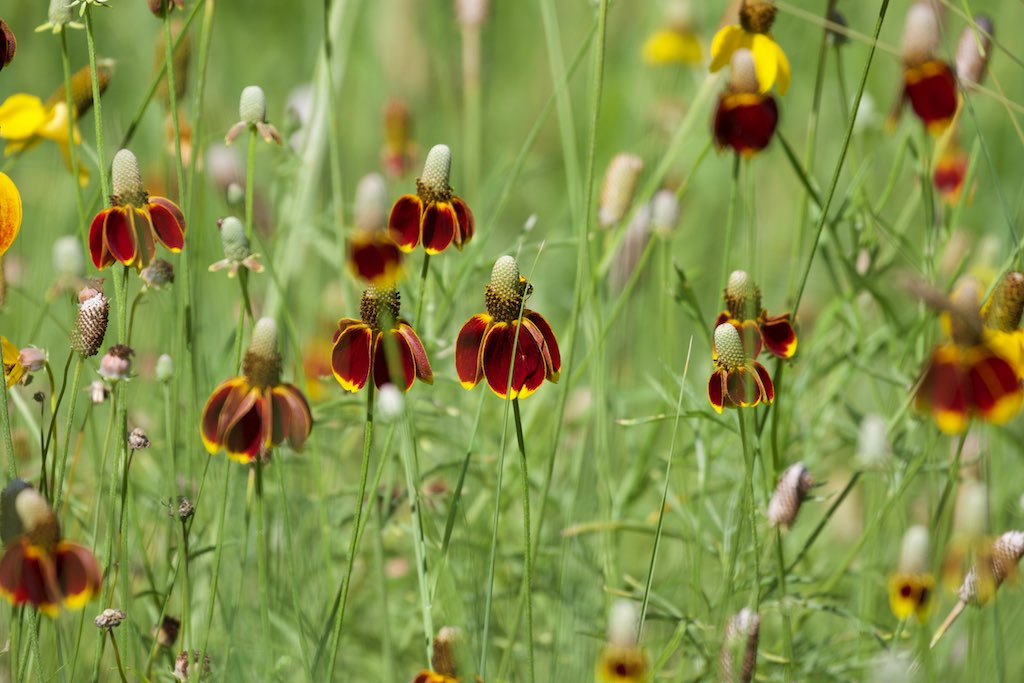
Prairie coneflower is a herbaceous perennial native to North America from southern Canada to northern Mexico where it grows in a variety of habitats such as prairies, plains, roadsides, and disturbed areas. It is a member of the aster family, Asteraceae, that also includes daisy, yarrow, and lettuce. Plants grow 6-60″ tall and have one to many erect branched stems with basal and/or cauline leaves that are linear to oblong, and pinnately lobed to pinnatified. Flowerheads are borne singly or in loose clusters and consist of 50-400+ yellowish green to purplish disc florets surrounded by 3-15+ (sometimes none) yellow, maroon or bicolored ray florets.
Plants grow best in full sun in average, dry to moderately moist, well-drained soil. Plants are drought resistant, and generally free from serious pests or diseases. Propagation is by seed. The flowerheads are attractive to pollinators including butterflies and the seeds are attractive to birds. Plants may be vigorous and crowd out less rambunctious plants.
The derivation of the genus name, Ratibida, is unknown.
Photo Credit: HarmonyonPlanetEarth, Wikimedia Commons
The environmental conditions of the Mid-Atlantic have resulted in at least 2 species of prairie coneflower native to the Mid-Atlantic but they may be native to other areas in the US too. The prairie coneflowers described here are native to at least 1 state in the Mid-Atlantic.
Upright Prairie Coneflower (Ratibida columnifera)
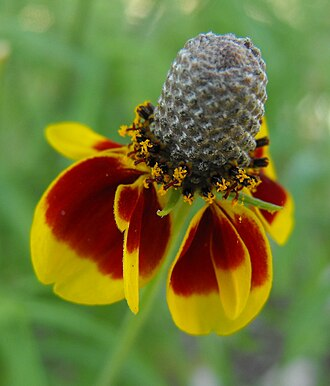
Hairy, green stems with occasional branching carry hairy leaves that are up to 6″ long, mostly at the base, and are deeply pinnate with 5-11 lobes. The single, terminal flowerheads consist of a long center cone up to 2″ long of purplish disk florets surrounded by 3-12 drooping yellow to rust red ray florets.
Alternate/s Names: Mexican Hat, red-spike Mexican hat, prairie coneflower, long-headed coneflower, thimbleflower, obelisk flower
Native Range: Delaware, New Jersey, New York, Pennsylvania as well as places on the Pacific Coast, and in the Rocky Mountain area, Southwest, Southeast, Midwest and New England
Habitat: Prairies, plains, pastures, meadows, savannahs, disturbed sites
Type: Perennial or biennial
Height: 1-3′
Bloom Time: Late spring to ealy fall
Bloom Color: Rust-red, yellow
Light: Full sun; tolerates some shade
Soil: Average, dry to medium moist, well-drained; tolerates drought and poor soil
USDA Hardiness Zones: 4-9
Photo Credit: Wikipedia
Gray-head Coneflower (Ratibida pinnata)
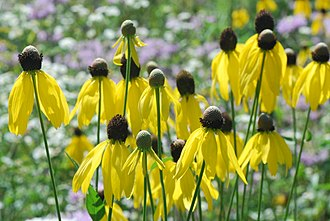
A slender, somewhat branched, hairy stem bears lower leaves that are up to 16 long, roughly hairy and glandular, and are deeply divided into 3-7 narrow lobes and may be further divided. The upper leaves are smaller and have fewer lobes or none. Long, ridged, rough stalks carry single flowerheads above the highest leaves and are composed of up to 15 drooping, yellow ray florets surrounding a roundish to ellipsoid, grayish cone-like center up to 1″ long bearing greenish yellow to purple disk florets that have an anise fragrance when crushed. The flowerheads are good in the vase.
Alternate/s Names: Pinnate prairie coneflower, yellow coneflower, prairie coneflower, grayhead Mexican, hat, weary Susan, drooping coneflower
Native Range: Pennsylvania as well as places in the Southwest, Midwest and Southeast
Habitat: Prairies, fields, thickets, woodland edges, savannahs
Type: Perennial
Height: 3-5′
Bloom Time: Mid summer to mid fall
Bloom Color: Yellow
Light: Full sun to partial shade
Soil: Average, medium moist to medium dry, well-drained; tolerates lean soil and drought
USDA Hardiness Zones: 3-8
Photo Credit: Wikipedia
The Mid-Atlantic region includes Delaware, Maryland, New Jersey, New York, Pennsylvania, and the District of Columbia. The region is characterized by cold winters and hot summers, high humidity in summer along some areas along the coast, and precipitation between 32 and 52″ per year.