
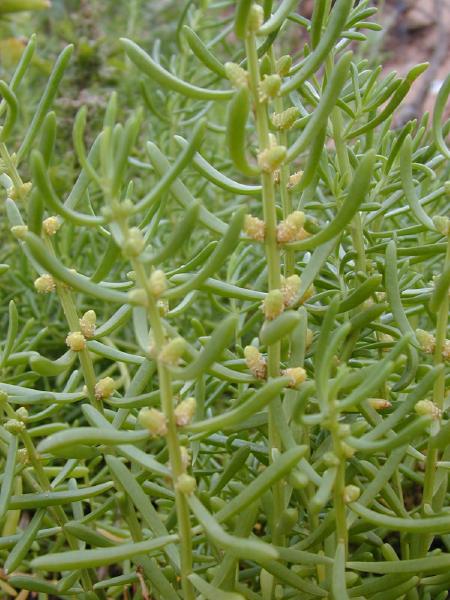
Also known as beachwort, turtleweed, barilla and camphire, this evergreen succulent shrub is native to tropical and subtropical coasts of the Americas from California to Peru on the west coast, and from North Carolina south to Florida and around the Gulf of Mexico, throughout the Caribbean, south to Brazil. It is a wetland species and and forms dense colonies in salt marshes, brackish marshes, and mangrove swamps, and frequently grows in mud and salt flats. A member of a small plant family, Bataceae, with only 2 species, the shrub grows 1-4′ tall and has trailing or ascending stems that carry bright green, club-shaped, succulent leaves .4-.8″ long that sometimes form roots when they touch the substrate. In addition, the leaves are fragrant when crushed, store salt in their tissues, and are eaten in salads. Inconspicuous solitary, white to green or yellow male and female flowers appear in late spring and summer, all year in some climates. The fruit is a green, fleshy, cylindrical berry. Saltwort is considered a pioneer species and is especially valued for habitat restoration after a hurricane and for dune stabilization. It is larval host plant and source of nectar for butterflies and is useful as a groundcover in a coastal gardens. In Hawaii the plant is considered invasive. The genus name, Batis, may be from the ancient Greek word βατίς (batís) meaning a flat fish, perhaps a skat or ray, but probably from Greek via Latin for another coastal plant, or possibly from Greek batos, meaning bramble. The specific epithet, maritima, is the Latin word for seacoast and refers to the natural habitat of the plant.
Type: Evergreen succulent shrub
Outstanding Feature: Foliage; tolerance of wet saline soil
Form: Rounded
Growth Rate: Moderate
Bloom: Inconspicuous white to green or yellow male and female flowers on different plants in late spring and summer
Size: 1-4′ H; spreading to be broader than tall
Light: Full sun
Soil: Sand, loam or clay, wet, acidic; tolerant of inundation by saline and brackish water; moderately tolerant of salt spray
Hardiness: Zones 7-11
Care: Low maintance
Pests and Diseases: None of significance
Propagation: Seed, ground layering, cuttings, and division
Outstanding Selections: None available
Photo Credit: Forest & Kim Starr USGS Wikipedia Commons