
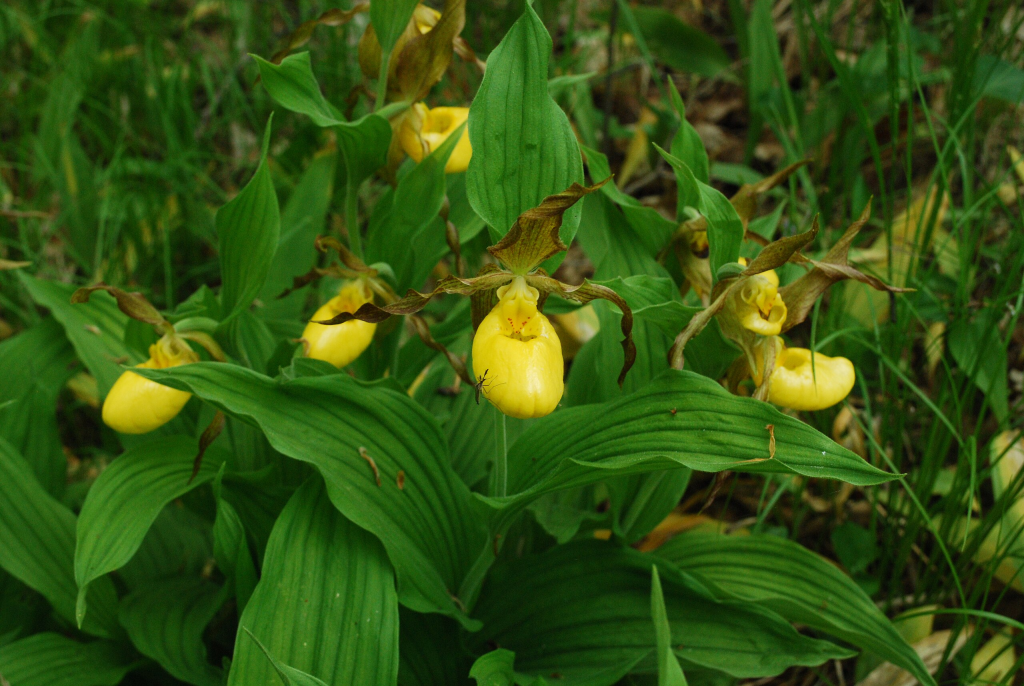
Also known as slipper orchids, moccasin flower, camel’s foot, squirrel foot, steeple cap, Venus’ shoes, and whippoorwill shoe, lady slipper orchids are a member of the orchid family, Orchidaceae, that is one of the two largest plant families and includes the vanilla plant. Most lady’s slipper orchids grow in temperate and subtropical climates of the Northern Hemisphere and are found in such habitats as moist woods, wetlands, and rocky outcrops. Plants are perennial, mostly terrestrial, and grow from a short hefty rhizome. Most slipper orchids have one or more erect stems 6-30″ tall, carrying 2-12 hairy leaves that are ovate to elliptic, to lanceolate, 1.5-10″ long, and pleated longitudinally. One to three (but up to 12) flowers appear at the tops of the leafy stems. The flowers have a showy inflated pouch (the slipper) that is yellow, white or pink and may be tinged or marked with other colors, inside and/or out. Sepals and petals are often the same color ranging from white to green to brown,, and may be spirally twisted. Bees are the most common pollinators but other insects may also be involved.
Most lady’s slippers prefer cool temperatures, part shade and moist soil, and are dependent on special soil fungi to complete their life cycle. Slugs are an occasional problem and shoot rot can occur if plants are watered excessively during their dormant period. Lady slippers are difficult to propagate and to grow in the garden and most harvested from the wild will die when transplanted. A few nurseries specialize in growing lady’s slippers and a limited number of species are available.
The genus name, Cypripedium, is derived from ancient Greek words Κύπρις (Kúpris), referring to the Greek goddess Aphrodite, and πέδιλον (pédilon), meaning sandal.
Photo Credit: Wikipedia
The environmental conditions of the Pacific Coast have resulted in at least four species of lady’s slipper native to the Pacific Coast but may be native to other areas in the US also. The lady’s slippers described here are native to at least two of the states of the Pacific Coast.
California Lady’s Slipper (Cypripedium californiccum)
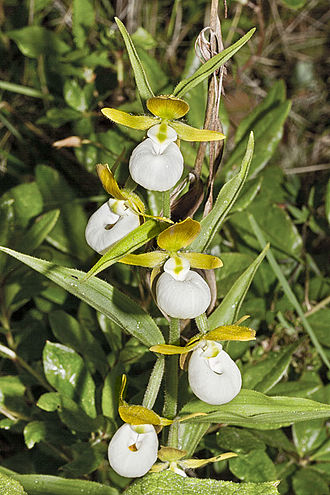
Stems up to 3′ tall carry 5 to 10 oval leaves that are 6-8″ long, pleated, and hairy. Up to 12 small flowers appear in the axils of the leaves. Each flower is about 1″ across and has a white or pink pouch with brownish purple veining inside, and yellowish brown sepals and petals.
Alternate Name/s: California Venus hoof
Native Range: California and Oregon
Habitat: Wet areas such as seeps, marshes and stream banks as well as in coniferous forest openings and steep slopes, usually with a serpentine substrate, in the mountains of southwestern Oregon and northern California
Type: Perennial
Height: 1-3′
Bloom Time: Late spring to summer
Bloom Color: White
Light: Part to full shade
Soil: Wet to boggy
USDA Hardiness Zones: 7-9
Photo Credit: Wikipedia
Clustered Lady’s Slipper (Cypripedium fasciculatum)
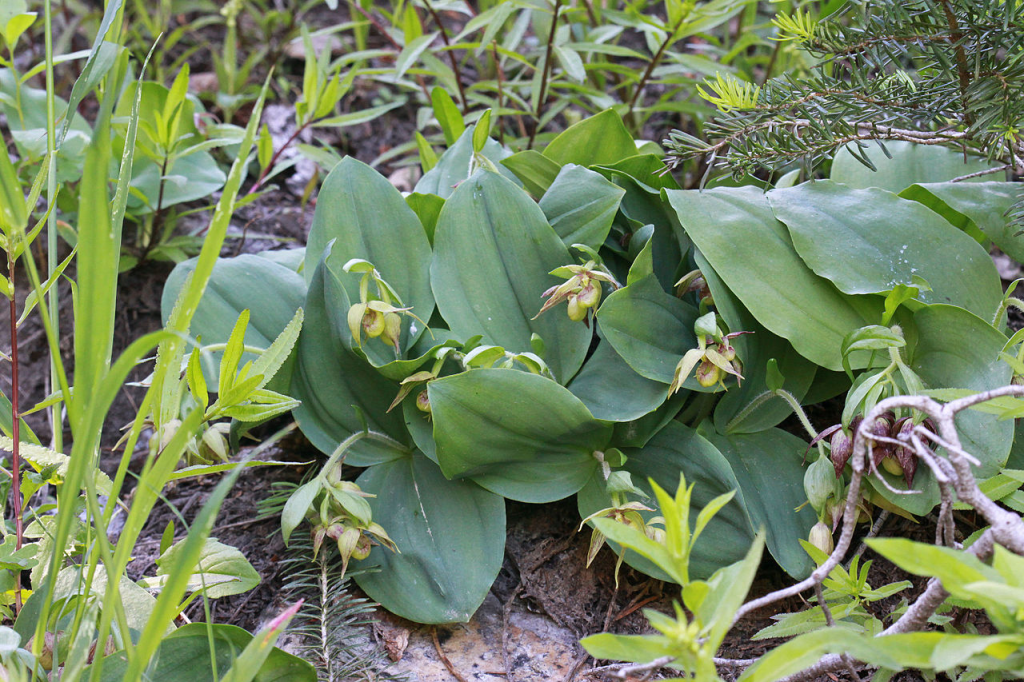
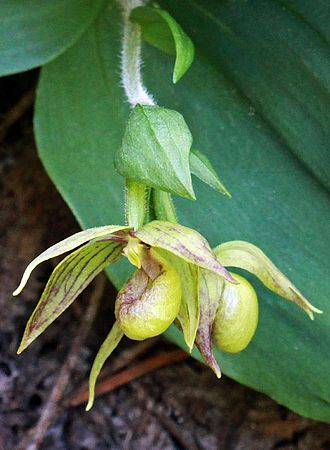
Short hairy stems bear two opposite rounded leaves that are 1.5-4″ long, pleated and often lie near the ground. Flowering stems bear a cluster of 2-9 terminal nodding flowers that may rest on the leaves or the ground. The flowers have a yellowish-green pouch with purple streaking near the opening, and green to purplish-brown sepals and petals. Photo Credit: Andrey Zharkikh, Wikimedia Commons
Alternate Name/s: Brownie lady’s slipper
Native Range: Washington, Oregon and California as well as parts of the Rocky Mountain area
Habitat: At high elevations in open coniferous forests, shrublands or thickets, and along stream banks on fairly steep slopes
Type: Perennial
Height: 12″
Bloom Time: Spring to summer
Bloom Color: Yellowish green, greenish brown to purplish brown to nearly red
Light: Partial to full shade
Soil: Moist to dry, well drained
USDA Hardiness Zones: Unavailable
Photo Credit: Wikipedia
Large Lady’s Slipper (Cypripedium montanum)
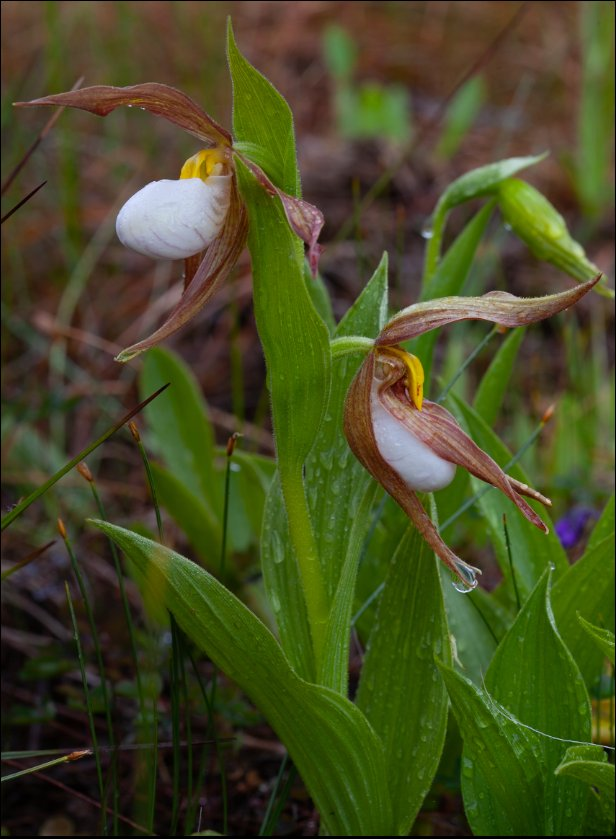
Stems carry 4-6, usually 5, plicated leaves that are broadly elliptic and 2-6″ long. One to three sweet-scented flower appear singly in each of the upper leaf axils. The pouch is .8 to 1.2″ long, and white with faintly purple veining near the base and purple spots inside. The sepals and petals are brownish purple, narrow and usually wavy and twisted.
Alternate Name/s: Mountain lady’s slipper, white lady’s slipper, moccasin flower
Native Range: Idaho, Montana and Wyoming as well as areas on the Pacific Coast
Habitat: Open mixed conifer or mixed conifer hardwood forests, forest openings, shrub thickets and alpine meadows in dry to moist soil, at elevations 1600 to 6900 feet.
Type: Perennial
Height: 8-28″
Bloom Time: Late spring to mid-summer
Bloom Color: White
Light: Part shade to sun
Soil: Dry to moist, well-drained; tolerates drier soil than most lady’s slippers
USDA Hardiness Zones: Unavailable
Photo Credit:
Greater Yellow Lady’s Slipper (Cypripedium parviflorum)
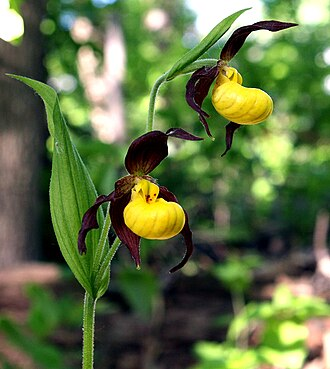
Hairy stems carry 2-5 clasping leaves that are 1.5- 6.5″ long, elliptical to oval, and hairy, and have distinct parallel veining. One to two terminal flowers have a pale to dark yellow pouch (rarely white) that is .75-1.25″ long and may have reddish to purplish spots on the pouch opening and faint purple venation on its lower area. Green, yellowish, or dark purple/brown sepals and petals are 2″ long and usually spirally twisted. Yellow lady’s slipper is one of the easier ones to grow so is a good choice for native plant, woodland, shade, meadow, prairie, and pollinator gardens.
Alternate Name/s: Yellow lady’s slipper, lesser yellow lady’s slipper, moccasin flower
Native Range: Washington, Oregon, and California as well as places on the, Rocky Mountain area, Southwest, Midwest, Southeast, Mid-Atlantic and New England
Habitat: Dry to mesic forests, woodlands, fens, prairies, meadows and along streams.
Type: Perennial
Height: 6-17″
Bloom Time: Late spring to early summer
Bloom Color: Yellow
Light: Part shade
Soil: Compost, medium moist, well-drained, acidic
USDA Hardiness Zones: 3-8
Photo Credit: Wikipedia
The three states of the Pacific coast, Washington, Oregon and California, have a great variety of geography and climate. The key factors uniting these states are the coastline along the Pacific Ocean and the presence of numerous mountain ranges. The area of the Pacific coast includes rainforests as well as semi-arid plateau and deserts. The climate varies with the geography with average annual rainfall ranging from over 130″ to less than 2″. Precipitation can be in the form of rain or snow. Likewise, summer temperatures can be over 110 F in Death Valley and down to -70 F in the mountains.