
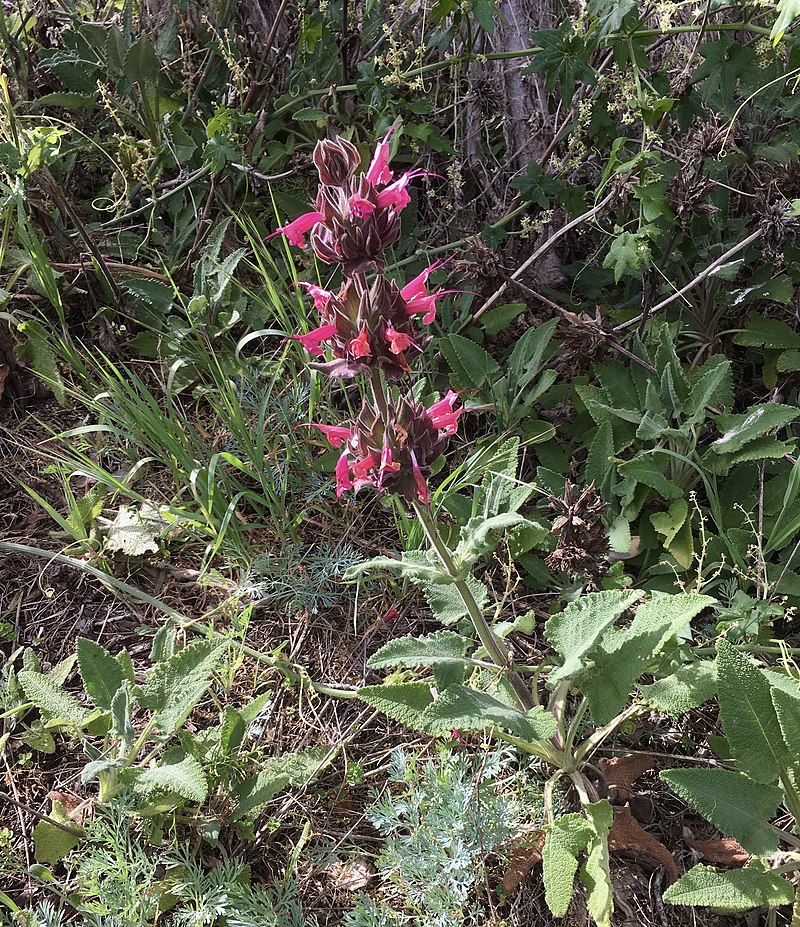
Also known as pitcher sage, this evergreen herbaceous perennial is native to southern and central California where it grows on open or shady slopes in moist oak woodland, chaparral, and coastal sage scrub not far from the Pacific Ocean. It is a member of the mint family, Lamiaceae, that also includes basil, beebalm, and lamb’s ear. Entirely covered with soft hairs, the plant forms loose mounds of light green foliage 4-12″ tall from a woody base and spreads by rhizomes to form clumps over 4′ wide. The oblong to arrow-shaped leaves are up to 6-10″ long, wrinkled on their upper surface, and aromatic when crushed. From late winter to summer, spike-like unbranched square stem up to 30″ long carry whorls of 10-20 flowers subtended by showy ruby red to dark maroon to brown. The rose pink flowers are up to 1″ long, fragrant, and attractive to hummingbirds, butterflies and other pollinators. Plants are resistant to deer and gophers. The entire plant is covered with wavy glandular hairs. Hummingbird sage does well in dry shade and can be used as a groundcover. It is an excellent choice for wildlife, butterfly, hummingbird, and native plant gardens. The genus name, Salvia, comes from the Latin word salvere, meaning to save and refers to the healing qualities associated with some species of the genus. The specific epithet, spathacea, comes from the Ancient Greek σπάθη (spáthē) meaning broad blade, and the suffix -aceous meaning resembling, and refers to the bracts subtending the whorls of flowers.
Type: Herbaceous evergreen perennial
Bloom: Spike of whorled rose pink flowers from late winter to summer
Size: 1-3′ h x 4-5′ W
Light: Prefers partial shade but tolerates part and full sun
Soil: Moderately fertile, medium moist to dry, well-drained; very drought tolerant once established
Hardiness: Zones 8-11
Care: Deadhead to prolong bloom; prune lightly in summer if necessary to maintain attractiveness
Pests and Diseases: Generally healthy but susceptible to damage by powdery mildew
Propagation: Seed, division
Companion Plants: Madrone (Arbutus menziesii), California peony (Paeonia californica), ocean spray (Holodiscus discolor)
Outstanding Selections:
‘Confetti’ ( both yellow and pink flowers on the same plant)
‘Powerline Pink'(magenta to crimson flowers; can grow in full sun)
‘Avis Keedy’ (light yellow flowers).
Photo Credit: docentjoyce Wikimedia Commons