
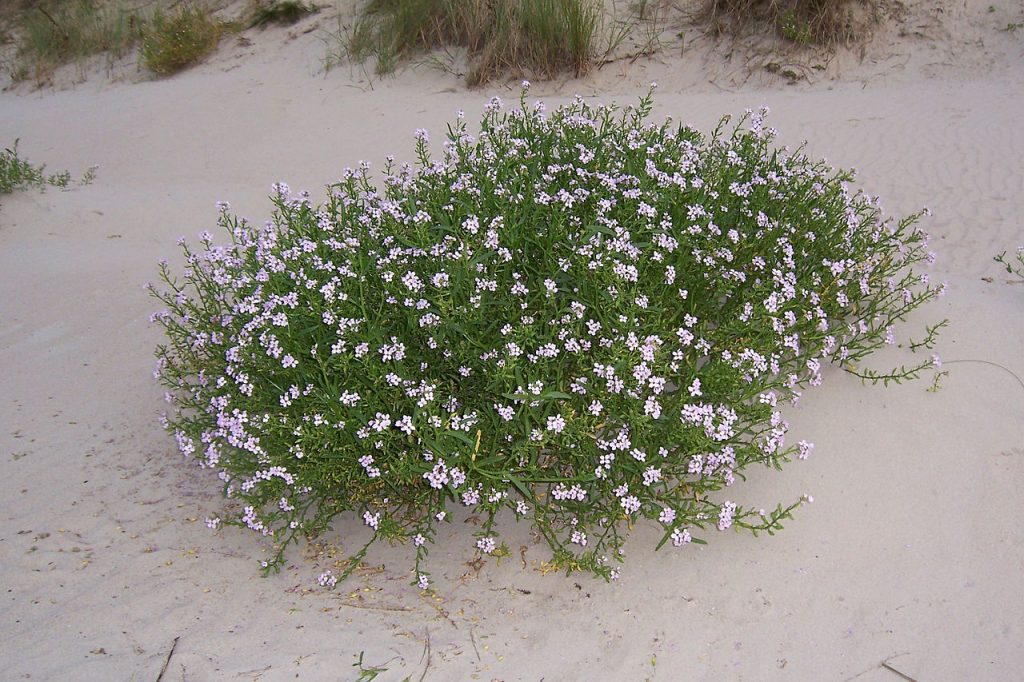
This succulent annual is native to sandy and shingly areas of coastlines of temperate areas in Europe, North Africa and western Asia and grows as an introduced species on both the east and west coasts of the US. It is a member of the mustard family, Brassicaceae, that also includes cabbage, alyssum, and stock. The plant grows about 1′ tall and has a stout taproot and a branched prostrate or ascending stem with fleshy, deeply pinnately lobed leaves. The leaves are 1.5-3″ long, and green tinted with purple or magenta. The lower leaves are obovate or oblanceolate with the upper ones are oblong. In summer, racemes 1.5-6″ long appear carrying white to lilac, 4-petaled flowers almost 1″ wide. The fruit is a short stubby capsule with 2 horns at the tip and contains 2 yellow or brown smooth seeds in each of its 2 compartments. Sea rocket is tolerant of salt spray and periodic seawater inundation, and growth is stimulated by burial with blown sand. Often a pioneer species, sea rocket can colonize bare sand and shingle close to the splash zone where few other plants are able to survive and is a good choice for dune restoration as well as a seaside garden. The genus name, Cakile, is an Arabic name of unknown origin. The specific epithet, maritima, is the Latin word meaning of the sea.
Type: Annual
Bloom: Racemes of white to lilac, 4 petaled flowers in summer
Size: 1′ x 1′ W
Light: Full sun
Soil: Sandy, medium moist, well-drained
Hardiness: Zones 5-9
Care: Low maintenance
Pests and Diseases: None of significance
Propagation: Seed
Companion Plants: Sea kale, sea beet, yellow horned poppy
Photo Credit: Jürgen Howaldt Wikipedia