
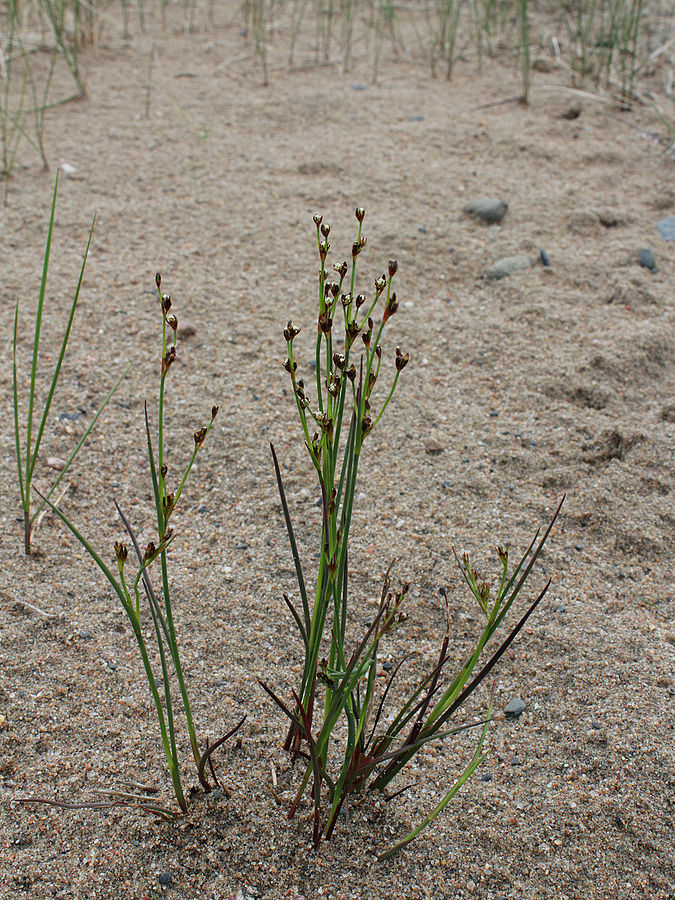
Also known as black grass, black needle rush, Gerard’s rush, mud rush, and saltmarsh rush, this herbaceous perennial is native to Eurasia and the Atlantic coast of North America where it grows in salt marshes. It is a member of the Juncaceae, a family of 464 species that superficially resemble grasses. The plant has a rhizomatous root system and forms a loose tuft 1-2′ tall. The 1-4 dull green leaves are stiff, wiry, flat, and have sheathing bases. The small green to brown flowers appear in terminal loosely branched cluster 1-4″ long in summer. The fruit is a light brown, egg-shaped capsule containing 3 seeds or more. Because of its tolerance of wet soils and flooding, saltmeadow rush is a good choice for pond margins, water gardens, marshes, and other wet areas. The genus name, Juncus, is from the Latin word jungere meaning to tie or bind, and may refer to the use of some species to make cord. The specific epithet, gerardii, honors John Gerard (1545–1612) English gardener and botanist.
Type: Herbaceous perennial
Bloom: Clusters of small green to brown flowers in summer
Size: 1-2′ H
Light: Full sun
Soil: Wet; tolerant of saline conditions
Hardiness: Zones 3-7
Care: Low maintenance
Pests and Diseases: Generally healthy but aphids can be a problem
Propagation: Seed, division
Companion Plants: Smooth cordgrass, glasswort, bigleaf marsh elder
Photo Credit: Matti Virtala Wikimedia Commons