
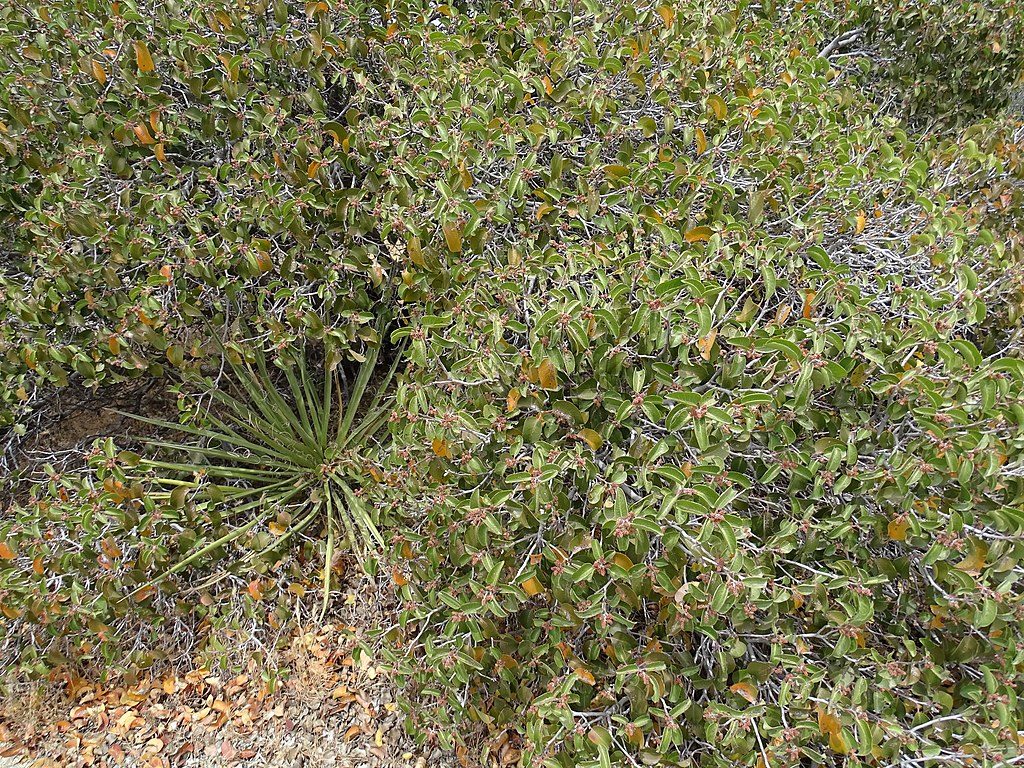
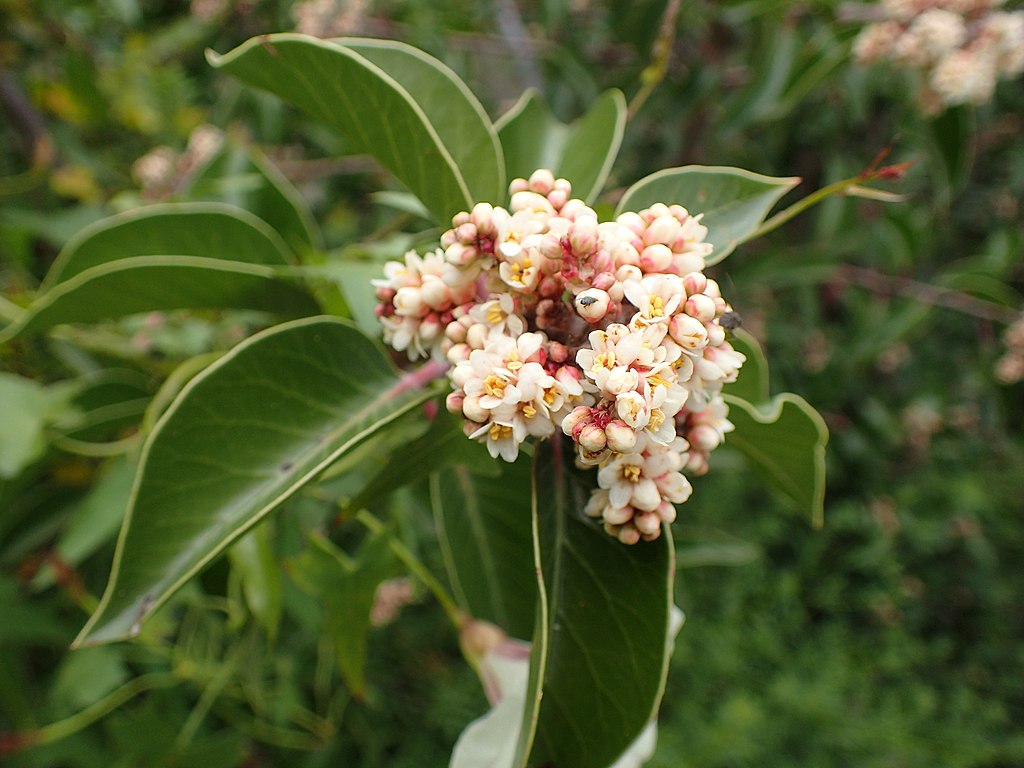
Also known as sugar sumac, this evergreen shrub or small tree is native to chaparral in dry canyons and slopes in Southern California, Arizona and Baja California and is a member of the cashew family, Anacardiaceae, that also includes smoke tree, mango, and poison ivy. The plant grows up to 15′ tall and has stout reddish twigs and smooth, leathery dark green leaves. The leaves are 1-2″ long, broadly ovate to broadly elliptical, and are folded at the midrib. In spring, terminal panicles of flowers appear with 5 white to pink petals and 5 reddish sepals. The flowers are less than 1/2″ wide, and may be pistillate (female) or bisexual, and attract butterflies and other pollinators. Pistillate flowers tend to produce the most fruit, a small sticky drupe that is attractive to birds and small mammals. The dense foliage of sugar bush makes it a popular plant for use a hedge and its great drought tolerance makes it useful for xeriscaping. In addition it is a good bank stabilizer but can grow very large and crowd out other plants. The genus name, Rhus, is the Greek name for one species, Rhus coriaria. The specific epithet, ovata, may be from the Latin word ova, meaning egg, referring to the shape of the leaves.
Type: Evergreen shrub or small tree
Outstanding Feature: Foliage, flowers
Form: Mounding
Growth Rate: Rapid once established
Bloom: Clusters of white to pink flowers in spring
Size: 4-15 h 4-15′ W
Light: Sun to partial shade
Soil: Average to lean, dry to medium moist, well-drained; very drought tolerant
Hardiness: Zones 8-11
Care: Low maintenance
Pests and Diseases: Oak root fungus
Propagation: Seed (soaked or heat treated), cuttings
Photo Credit: Jesse Rorabaugh Wikimedia Commons (upper) George Williams Wikimedia Commons (lower)