
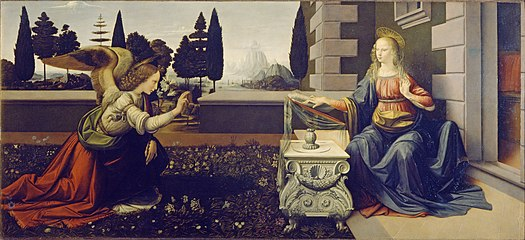
The name Our Lady’s Eardrops for Fuchsia magellanica is relatively recent and is based on the shape and appearance of its flowers. The plant was introduced to Europe in the late 17th to early 18th century after Spanish explores brought plants back from South America where the plant was native. The pendulous, tubular blossoms resemble “eardrops” the old-fashioned term for dangling earrings. They were considered an appropriate adornment for the ears of Mary at the Annunciation when the angel Gabriel came to Mary and said , “Do not be afraid, Mary; you have found favor with God. You will conceive and give birth to a son, and you are to call him Jesus. He will be great and will be called the Son of the Most High.” (Luke 1 30-32)
Photo Credit: Wikipedia, Annunciation by Leonardo da Vinci
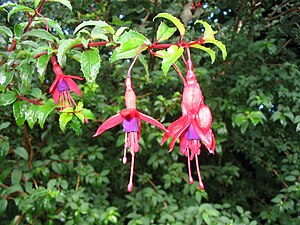
Also known as hardy fuchsia and hummingbird fuchsia, this deciduous sub-shrub is native to temperate areas of southern Chile and Argentina where it grows in scrublands, and forest clearings and margins. It is a member of the evening primrose family, Onagraceae, that also includes, Clarkia and Gaura. The plant forms a bushy clump 6-10′ tall and has dark green leaves that are ovate to lanceolate, 2-5″ long and have dentate margins. Pendant tubular flowers with prominent stamens appear from summer to frost. The flowers are magenta to red and are attractive to hummingbirds and bees.
The genus name Fuchsia honors Leonhard Fuchs (1501–66), German botanist and doctor. The specific epithet, magellanica, refers to the Strait of Magellan and reflects the geographic origin of the species
Garden fuchsia likes dappled to partial shade and fertile, consistently moist, well-drained soil in USDA Hardiness Zones 6-9. It is susceptible to damage by gall mites, spider mites, scale, thrips, whiteflies, aphids, root-knot nematodes, rust, Verticillium wilt, crown gall, mold, blight, and rots. Pruning in spring encourage bushiness. Propagation is by softwood cuttings in spring, semi-ripe cuttings in summer and seed.
Photo Credit: Wikipedia
 Karen
Karen