
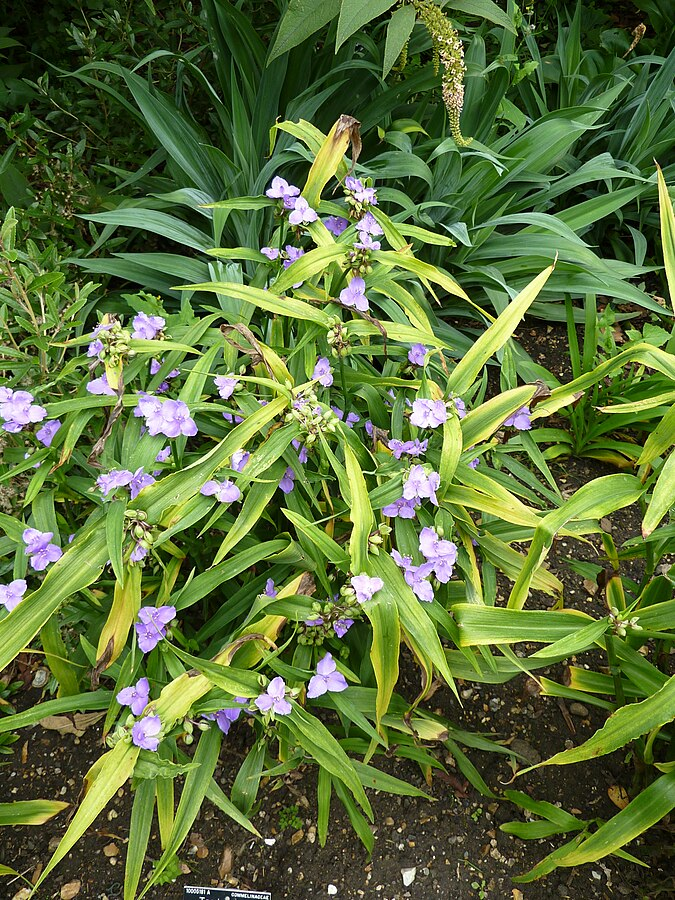
In the Catholic tradition, Mary endured seven sorrows and is often shown grieving in art related to the Crucifixion, Lamentation, and Pietà. Tears are a part of sorrow and grieving and two plants are associated with Mary’s tears, lily of the valley and spiderwort. When the stems of spiderwort are cut or broken, they exude a clear, watery sap and when the petals wilt they dissolve into drops of liquid. Both the sap and the wilted petals can resemble tears.
Photo Credit: Wikimedia Commons
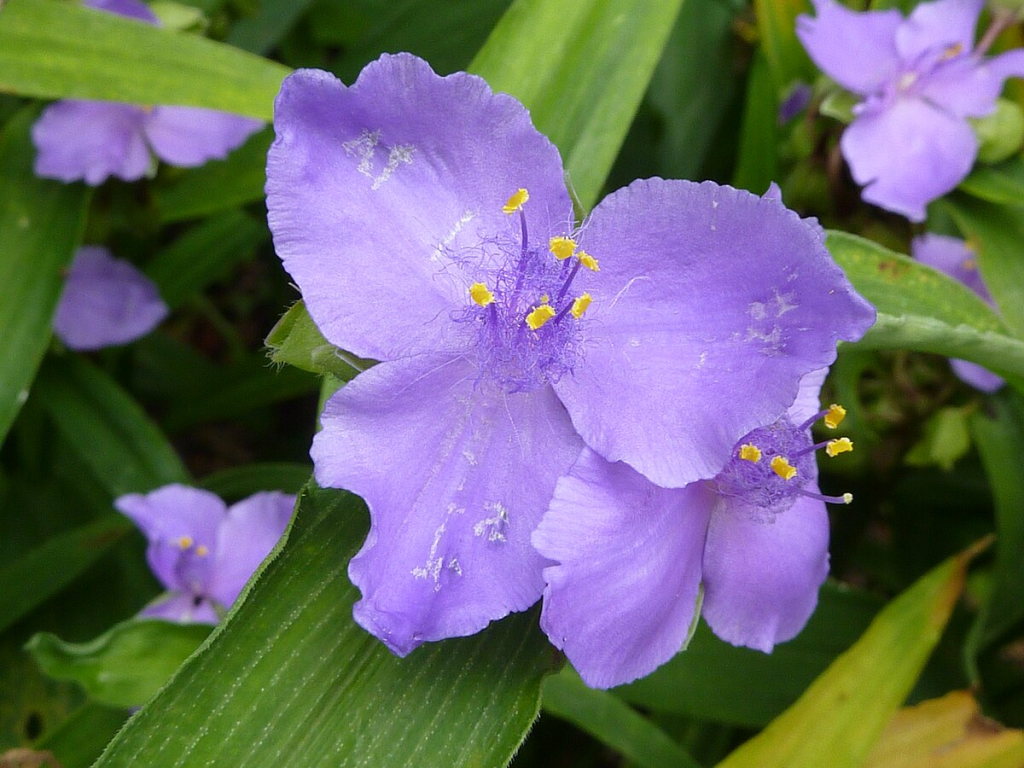
Also called spider lily, this herbaceous perennial is native to eastern US North, where it grows in moist soils of prairies, woodlands, meadows, and hillsides. It is a member of the family, Commelinaceae, a family of 731 species. The plants grow in clumps up to 3′ tall and have tubular branched stems and narrow, arching, bright green leaves. The leaves are up to 1′ long and are angularly arranged so that they resemble a squatting spider. Unfortunately, the leaves decline by mid summer and are unsightly. From spring into summer terminal umbels of blue or purplish flowers appear. Each flower is 2″ across and has three petals and showy yellow stamens. The flowers are open only in the morning of one day and then the petals wilt and dissolve into drops of liquid. So many buds are produced, however, that the plant seems to be constantly in bloom for weeks.
The genus name, Tradescantia, honors John Tradescant (1608-1662) who served as gardener to Charles 1 of England. The specific epithet, virginiana, is the Latinized name for Virginia, a place where the plant is native.
Spiderwort likes full sun to partial shade and average, moderately moist, well-drained soil in USDA Hardiness Zones 4-9. Plants are easy to grow, have no significant pests or diseases, and can be propagated by division in spring or fall.
Photo Credit: Wikimedia Commons
 Karen
Karen 
