
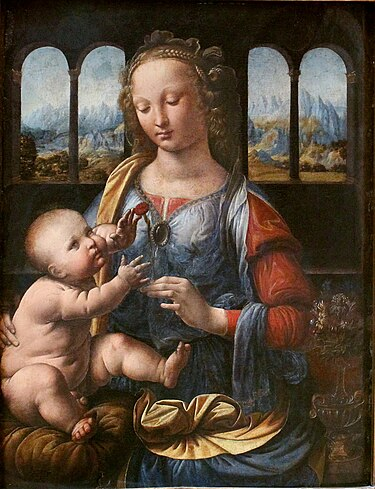
The link between Dianthus carophyllus and Mary is based on legend. One legend tells us that it bloomed on the night of Jesus’ birth as a sign of Mary’s joy. Another tells us that when Mary saw Jesus carrying the cross to his crucifixion, she wept in sorrow and carnations bloomed where her tears fell to the ground. As a result, carnations, especially pink ones, became a symbol of a mother’s constant love and devotion. Leonardo da Vinci’s painting of the Madonna and Baby Jesus (shown here on the right) shows Mary holding a red carnation, perhaps symbolizing the Passion.
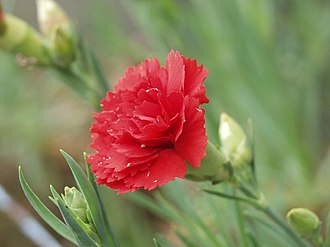
Carnations are short-lived herbaceous perennials native to the Mediterranean where they grow in pockets of soil in limestone formations. The grey-green foliage is linear and evergreen. The flowers are produced singly or in clusters of five in summer and usually have a strong sweet clove fragrance. The species was originally bright pinkish purple but white, yellow, red, purple, and green cultivars have been developed. Photo Credit: Wikipedia
The genus name, Dianthus, comes from the Greek words Δῖος (dios), meaning divine, and ἄνθος (anthos) meaning flower. The specific epithet, caryophyllus, comes from the Greek word καρυόφυλλον (karyophyllon), which was used to describe the clove tree (Syzygium aromaticum) and was later applied to carnations because of their clove scent.
Carnations like full sun and fertile, moist, well-drained, limy soil in USDA Hardiness Zones 6-8. Plants have many viral, bacterial, fungal diseases and insect pests. They are short lived and must be divided every other year to maintain vigor. Propagation is usually by slip cuttings in spring and summer.