
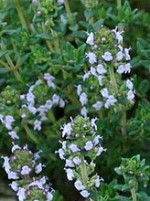
For thousands of years thyme has enjoyed great respect and usage. As early as 2750 BC the ancient Sumerians used thyme as a poultice and antiseptic and the Egyptians used it for embalming. The ancient Greeks burnt it as incense in temples, used it in their baths, and associated it with courage. Likewise, the ancient Romans thought thyme was a symbol of courage and bravery. By Medieval times, thyme was a staple in herbal medicine and knights carried thyme as a token of bravery and protection. As legends and folklore grew, thyme was associated with the Virgin Mary. One story tells us that Joseph included thyme in the herbs he gathered to make a soft bed for Mary and Jesus at the Nativity and thyme became known as Mary’s bedstraw.
Over the ages, the many attributes of thyme has led it to become a symbol of purity, healing, protection, courage, bravery, all attributes of Mary. In addition, thyme symbolizes Mary’s humility and perseverance perhaps because it is a delicate plant that creeps along the ground and is able to grow in harsh conditions. The many attributes of thyme enhance Mary’s role as a symbol of compassion, motherhood, and divine grace.
Also called English thyme, this well branched aromatic evergreen shrub is native to the western Mediterranean region to southern Italy. It is a member of the mint family, Lamiaceae, that also includes basil, rosemary, and beebalm. Plants grow 3-12” tall and have a woody base and ¼” –1/2” long lanceolate gray-green leaves with margins rolled under. The ¼” tubular lilac to pink flowers are carried in whorls in small terminal clusters from late spring to early summer and are attractive to pollinators. Thyme honey is especially prized.
The genus name, Thymus, may be related to a Greek word meaning smoke, referring to the use of the plant in sacrifices during ancient times. The specific epithet, vulgaris, is the Latin word meaning common and refers to the wide spread occurrence of the plant.
Thyme like average, dry to medium, well drained soil and full sun in USDA Hardiness Zones 5-9. It is susceptible to damage by fungal diseases and root rot if grown in overly moist soil and can be infected by spider mites. Propagation is by layering and cuttings in spring, division in spring or fall; and seed. to encourage new grow cut back to 3″ in spring, shear after blooming, and replace when bushes get woody (every 2-3 years).