
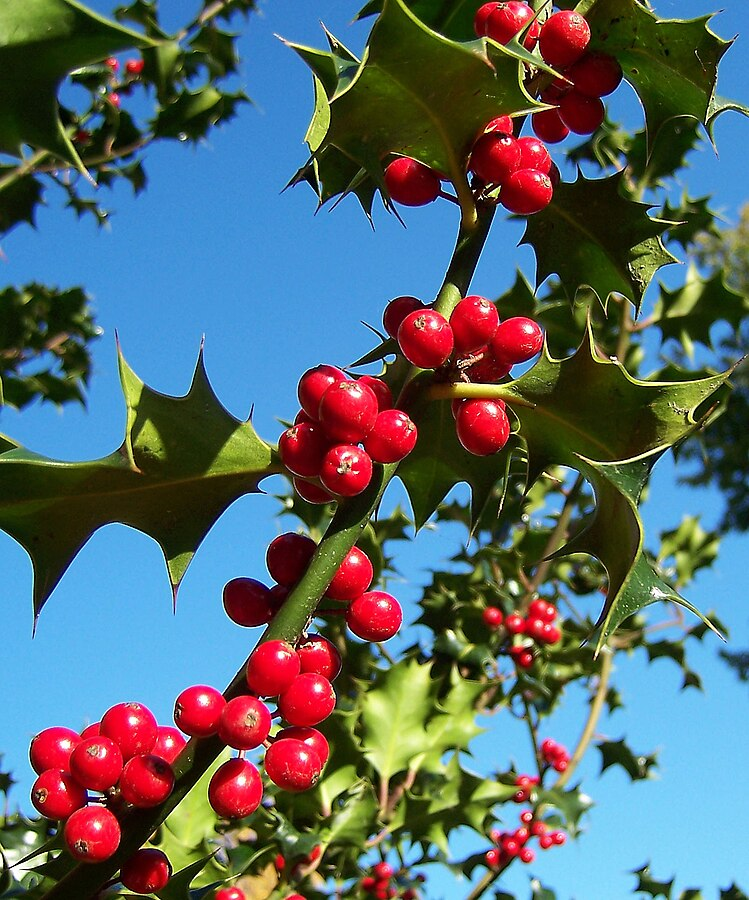
The association between English holly and the Virgin Mary has its origins in pagan times. The ancient Romans used holly in their celebration of the Saturnalia, a festival honoring Saturn, the god of agriculture, abundance and renewal. Saturnalia occurred before the winter solstice and continued until December 25, the date of the winter solstice by the Julian calendar. Early Christians adopted holly into their customs and saw its evergreen habit as a symbol of eternal life, its sharp pointed leaves as the crown of thorns and the berries as the blood of Christ shed as he died on the cross. Both the leaves and berries reminded the faithful of the pain and sorrow Mary suffered at the crucifixion of her son.
Photo Credit: Wikimedia Commons
Also known as common holly, European holly, and Christmas holly this evergreen tree is native to western and southern Europe, northwest Africa, and southwest Asia where it grows in the understory of deciduous forests. It is in the plant family Aquifoliaceae that consists of 400 to 600 species including deciduous trees as well as shrubs, and climbers. The tree grows 30-80′ tall with a pyramidal form and has shiny dark green leathery leaves that are oval in shape and about 2-5 inches long. The young leaves and those on the lower branches bear three to five sharp spines on each side, alternately pointing upward and downward. In spring, clusters of fragrant, small white male and female flowers appear on different trees. Pollinated female flowers give way to red or yellow berries in the fall. The berries are attractive to birds.
The genus name, Ilex, was the ancient Latin name for the evergreen, holm oak. The specific epithet, aquifolia, comes from the Latin words acus, meaning needle, and folia, meaning leaf, referring to the spiny nature of the leaves.
English holly likes sun to partial shade and average, consistently moist, well-drained soil in USDA Hardiness Zones 7-9. It is not tolerant of high heat and humidity. Plants are generally healthy but can be damaged by root rot, anthracnose, tar spot, leaf blight or cankers in poorly drained soil. Propagation is by seed or cuttings.