
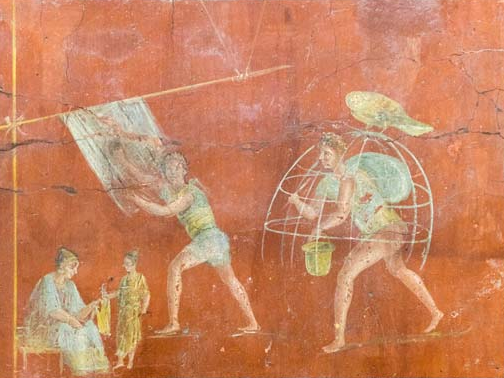
The association between the the Virgin Mary and fuller’s teasel is tenuous and rests on tradition and folklore rather than on biblical evidence. According to legend, Mary was dedicated to the Temple in Jerusalem by her parents, Joachim and Anna, and lived there from the age of three until marriage to Joseph. During her time at the Temple she was one of several virgins chosen to create the Temple veil. Her work on the Temple veil associated Mary with sewing and weaving and one of the tools used in weaving was teasel. Its dried flower heads were traditionally used for raising the nap on fabrics, particularly wool, and although there is no direct evidence that Mary ever used teasel, her association with the plant became fixed. The flower heads resemble brushes and led to the name “Our Lady’s Little Brushes”. Teasel’s connection to weaving further enhances the domestic and caregiving roles symbolically assigned to Mary.
Phot Credit: Fresco of fullers from ancient Pompeii, Wikipedia
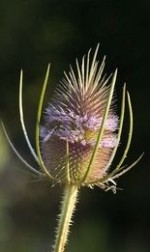
Native to damp grassland and woodland areas in Eurasia and North Africa, this herbaceous biennial is a member of the honeysuckle family, Caprifoliaceae, that also includes weigela, scabiosa, and abelia. In the first year, the plant grows a tap root and forms a rosette of large coarse lanceolate leaves up to 12″ long. In the second year several spiny stems up to 6’ tall arise bearing sessile spiny leaves and clusters of spiny flowerheads from summer into fall. Each egg-shaped flowerhead is up to 4″ long and consists of numerous small pink, purple or lavender flowers, subtended by long pointed bracts. The flowerheads produce an abundance of 1 seeded fruits, called achenes. Butterflies and bees love the flowers, birds, especially goldfinches, love the seed, and the dried seed heads look fabulous in dried arrangements.
The genus name, Dipsacus, comes from the Greek word dipsa meaning thirst of water and refers to the cup-like formation made where sessile leaves merge at the stem. The specific epithet, fullonum, comes from the Latin word fullo meaning fuller and refers to the use of the seed heads in the manufacture of wool cloth by fullers.
Fuller’s teasel likes full sun to part shade and moderately fertile, medium moist, well-drained soil in USDA Hardiness Zones 3-8. Plants have no significant pests or diseases, are low maintenance, but can become invasive and may be considered weeds. Propagation is by seed.
Photo Credit: Wikipedia