
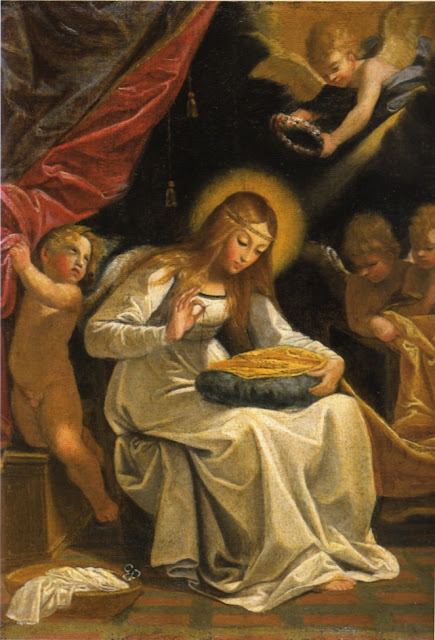
The association between harebell and the Virgin Mary is the result of medieval Christian traditions and folklore. Although the Bible makes no mention of Mary’s domestic skills, the veneration of Mary that arose in the Middle Ages led to legends and stories that emphasized Mary’s nuturing, motherly qualities. Mary was seen as humble and industrious and she is sometimes shown sewing or weaving in the art of the Renaissance and Baroque periods, such as shown by the work on the right painted by Simone Cantarini(1612-1648). The harebell’s dainty, bell-shaped flowers resemble tiny thimbles, and so the plant was given the name “Our Lady’s Thimble”.
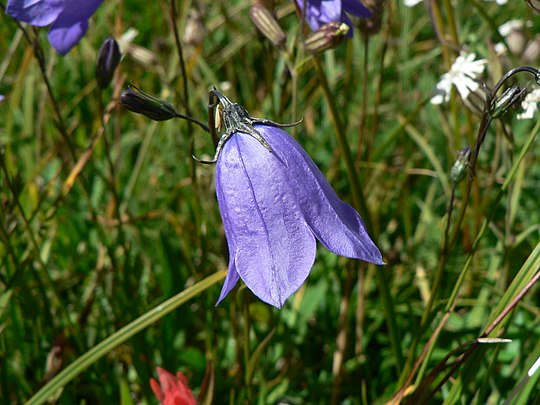
Also known as the bluebell of Scotland, harebell is a rhizomatous herbaceous perennial and a member of the Campanulaceae family that also includes ladybell (Adenophora), balloon flower, and Lobelia. It is almost circumboreal in distribution and found in many of the cooler regions of North America and Europe where it grows in dry, nutrient-poor grasslands , savannahs, prairies, and heaths, often in rock crevices, cliff faces, and dunes. Plants form a basal rosette of 1″ wide rounded toothed leaves on long petioles but these leaves often disappear before the flowers bloom. Several unbranched wiry flowering stems arise from each rosette bearing 2-3″ long grass-like leaves and carrying terminal flowers singly or in clusters throughout the summer. The bell-shaped flowers are nodding, blue, and 1/2 to 1″ wide.
The genus name, Campanula, comes from the late Latin word, compana, meaning bell and refers to the form of the flowers. The specific epithet, rotundifolia, comes from the Latin words rotundatus, meaning round, and folia meaning leaf, and refers to the shape of the leaves.
Harebell likes full sun and average, consistently moist, well-drained soil in USDA Hardiness Zones 2-7. It prefers cool climates, tolerates some shade, and is drought tolerant once established. Plants are generally healthy but may suffer damage from slugs and snails. Propagation is by seed, basal cuttings, and division every 3-4 years.