
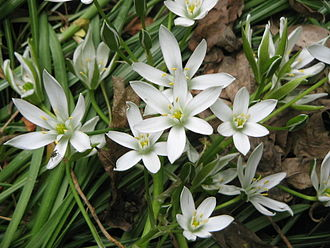
Several different legends connect Ornithogalum umbellatum to the Virgin Mary. The most well-known says that after a bright star guided the Magi to the manger where Mary tended to the Christ child, it shattered and fell to earth. The pieces were transformed into the delicate white starshaped flowers of the plant that we now call Star of Bethlehem. Another legends says that these flowers grew along Mary’s path as she fled to Egypt with Joseph and baby Jesus, while still another claims that the plants sprouted from Mary’s tears as she cried at the Crucifixion. In addition, the white color of the flowers is associated with Mary and symbolizes her purity. Photo Credit: Wikipedia
This perennial bulb goes by many common names including bird’s milk, grass lily, nap-at-noon, summer snowflake, starflower, and ten-o’clock lady. It is native to damp habitats in Europe, northern Africa, and the Middle East and is a member of the asparagus family, Asparagaceae, that also includes lily of the valley, hosta, and yucca. Plants grow 6-12″ tall and have a basal clump of 6-10 grass-like leaves 6-12″ long. The leaves begin to fade when leafless flower stems appear bearing terminal umbels of 10-20 star like flowers from late spring to early summer. Each flat, star-shaped flower is up to 3/4″ wide and has 6 lanceolate tepals that are white and striped green on the outside. Flowers open from noon to about sunset and are closed on cloudy days
The genus name Ornithogalum, comes from the Greek words ὄρνις (ornis) meaning bird, and γάλα (gala) meaning milk, and refers to the white flowers. The specific epithet, umbrellatum, is from the classical Latin word umbrella, meaning umbrella, and refers to the umbrella-like shape of the inflorescence.
Star of Bethlehem likes full sun to partial shade and average, moderately moist, well-drained soil in USDA Hardiness zones 4-9 but can not tolerate late summer rains. Plants are generally healthy but may develop bulb rot if rains come in late summer when the bulbs are dormant. Propagation is by division of offsets.