
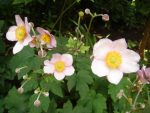
Also called Japanses anemone, this herbaceous perennial is a native of central China where it grows in scrub, grassy slopes, and streamsides. It is a member of the buttercup family, Ranunculaceae, that also includes delphinium, clematis, and hellebore. Plants grow from a thick tuberous root system and form a 12″ tall basal clump of dark green leaves that are toothed, 3 lobed, and have soft hairs on their underside. The leaves are 10-12″ long and are carried on long petioles. From late-summer into fall plants produce long, wiry, branching flower stems well above the foliage bearing solitary, cup-shaped flowers that are 2-3″ across and consist of 5-7 rose pink tepals surrounding a center of yellow stamens. Plants are especially valued for the late bloom time and are useful in borders and informal gardens. The genus name, Anemone, is probably a corrupted Greek loan word of Semitic origin referring to the lament for the slain Adonis or Naaman, whose scattered blood produced the blood-red Anemone coronaria. The specific epithet, hupehensis, honors the province. Hupeh, in Central China where the plant is native.
Type: Herbaceous perennial
Bloom: Rose pink flowers 2-3″ across from late summer into fall
Size: 18-30″ H x 12- 18″ W
Light: Part shade to full sun with afternoon shade in hot climates
Soil: Average, consistently moist, well-drained, slightly alkaline
Hardiness: Zones 4-8
Care: Low maintenance
Pests and Diseases: Plants generally healthy but susceptible to foliar nematodes, leaf spot, downy mildew, powdery mildew, rust, caterpillars, flea beetles, weevils, and slugs.
Propagation: Division, root cuttings
Companion Plants: Coneflower “White Swan’, mountain fleece, rubrum lily
Outstanding Selections:
‘September Charm’ (rose colored flowers that fade towards the center)
‘Superba’ (more vigorous than the species; 2.5′ tall)
Photo Credit: Wikipedia
 Karen Meyers