
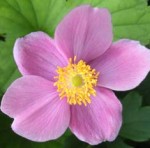
Hybrid Japanese anemone is a herbaceous perennial often sold as A, japonica. It is a member of the buttercup family, Ranunculaceae, that also includes delphinium, clamatis, and hellebore. Plants form a substantial mound of handsome dark green leaves with long stems (petioles). Each leaf is palmately compound with three toothed leaflets. The flowers are two to five inches across and lack petals but have white or pink petal-like bracts that that surround a yellow center. Flowers may be single, semi-double or double and appear on wiry well branched stems in late summer into fall over a long bloom time. Plants may be slow to flower but once established can be very vigorous. There are many cultivars available varying most significantly in flower color and fullness. Plants are a good choice for beds and borders as well as cottage, woodland, meadow and prairie gardens. Both the leaves and flowers are good in the vase together or separately and individual flowers can be dried. The genus name, Anemone, is probably a corrupted Greek loan word of Semitic origin referring to the lament for the slain Adonis or Naaman, whose scattered blood produced the blood-red Anemone coronaria.
Type: Herbaceous perennial
Bloom: White or pink flowers with yellow center from late summer into fall
Size: 4-5′ H x 2′ W
Light: Full sun to part shade
Soil: Average, consistently moist, well-drained
Hardiness: Zones 4-8
Care: Low maintenance but some plants may need staking.
Pests and Diseases: None of significance but plants susceptible to leaf spot, downy mildew, powdery mildew, rust, smut, caterpillar nematodes, lugs, black blister beetles, Japanese beetles.
Propagation: Division, root cuttings
Companion Plants: Asters, goldenrod, toad lily, monkshood
Outstanding Selections:
‘Honorine Jobert’ (single, white, 3′ tall)
‘Prince Henry’ (semi-double deep rose)
‘Queen Charlotte’ ( semi-double, pink, 3.5′ tall)
‘September Charm’ (single,silvery pink)
‘Whirlwind’ (semi-double pure white, 3-4′ tall)
 Karen Meyers