
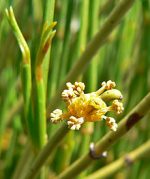
 Also known as Indian tea and green ephedra, this evergreen coniferous shrub is native to western US from the Arizona deserts to California, east of the Sierra Nevada, San Joaquin Valley and southern mountains, and to Utah, the western edge of the Colorado desert into southwestern Wyoming. It grows in varied scrub woodland, desert, and open habitats at elevations bewtween 3,000 and 7,500ft. As member of the Ephedraceae family, Mormon tea belongs to the only genus in the family but is one of over 70 species. Plants grow 3- 4′ tall and have dense clusters of thin green evergreen stems aging to yellow and bearing tiny pairs of insignificant awl-shaped leaves at the nodes. In spring, clusters of 2-5 male and 2-6 female flowers are produced at the nodes of different plants. Male pollen cones are smaller than the female seed cones. The plants are considered effective all year round and are valued in desert gardens and xeriscapes. The genus name, Ephedra, is the Greek name for common mare’s tail (Hippuris), that it somewhat resembles. The specific epithet, viridis, is the Latin word for green and refers to the stem.
 Type: Evergreen coniferous shrub
Outstanding Feature: Evergreen stems
Form: Upright
Growth Rate: Slow
Bloom: Yellow flowers in the spring
Size: 3-4′ H
Light: Full sun
Soil: Average to lean, dry, well-drained
Hardiness: Zones 5-10
Care: Low maintenance
Pests and Diseases: None of significance
Propagation: Seed, division, layering
Photo Credits: Wikipedia
 Karen Meyers