
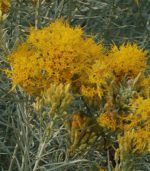
Rubber rabbitbrush is a deciduous shrub and a member of the aster family, Asteraceae, that also includes daisies, yarrow, and lettuce. It is naive to the western third of the US except the Pacific Northwest and grows in open sunny areas with dry soil in foothills, mountains, valley bottoms, plains, and high deserts, often associated with sagebrush. The well branched plants grow four to eight feet tall and have yellowish-green stems that are covered with woolly gray, green, or white hairs that give off an unpleasant order when crushed. The almost needle-like leaves are up to 2 3/4 inch long and are often woolly and foul smelling when bruised. The flowerheads appear in terminal umbel-shaped clusters from mid summer into fall and consist entirely of pungent yellow tubular disc flowers. The fruits are achenes with tufts at the tip. Plants spread by seed and resprouts from basal buds. Very drought tolerant, rubber rabbitbrush is an excellent choice for a xeriscape or desert garden. The genus name Chrysothamnus, comes from the Greek words χρυσός (chrysos) meaning golden and θάμνοςth (thamnos) meaning shrub and refers to the flowers of the shrubby plant. The specific epithet, nauseosus, is Latin for heavy scented and refers to the foul smell of the stems and leaves. As the common name suggests the plant contains latex in its sap but not in quantities that make rubber production profitable.
Type: Deciduous flowering shrub
Outstanding Feature: Yellow flowers
Form: Rounded
Growth Rate: Rapid
Bloom:Terminal clusters of flowerheads consisting of yellow tubular disc flowers from mid summer to fall
Size: 4-8′ H
Light: Full sun
Soil: Average to lean, dry, well-drained, alkaline
Hardiness: Zones 4-8
Care: Prune hard in early spring to promote bushiness.
Pests and Diseases: None of significance
Propagation: Seed, division, stem cuttings
Companion Plants: Blanketflower (Gaillardia aristata), Indian paintbrush (Castilleja spp.), prairie coneflower (Ratibida columnifera)
 Karen Meyers