
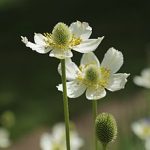
This rhizomatous herbaceous perennial is also known as timbleweed (along with several other plants) and is a member of the buttercup family, Ranunculaceae, that also includes delphinium, clematis, and hellebore. It is native to rocky and dry open woodlands and dry slopes in central and eastern North America and grows 1-2′ tall. The dark green leaves are 3 lobed and are clustered in whorls half way up the stem. They may take on reddish tinge in the fall. From early spring to summer solitary white or greenish-white star-shaped flowers appear that are 1″ wide and have a central mound of numerous greenish or yellowish stamens. They are carried well above the foliage and give way to thimble-shaped seedheads that persist into winter. The plants are useful in woodland, wildlife, native plant, and shade gardens. Tall anemone is not as aggressive as most other anemone species and tolerates full shade. The genus name, Anemone, is probably a corrupted Greek loan word of Semitic origin referring to the lament for the slain Adonis or Naaman, whose scattered blood produced the blood-red Anemone coronaria. The specific epithet, virginiana, refers to Virginia one of the locations the plant is native.
Type: Herbaceous perennial
Bloom: Solitary white to greenish-white flowers with a raised mound of greenish to yellowish stamens from early spring to early summer
Size: 1-2′ H x 1-1.5′ W
Light: Full sun, part sun, part shade; tolerates full shade.
Soil: Average, dry to medium moist, well-drained
Hardiness: Zones 2-8
Care: Low maintenance
Pests and Diseases: None of significance
Propagation: Division, seed
Companion Plants: Aquilegia canadensis, Geranium maculatum, Phlox divaricata, Amsonia tabernaemontana
 Karen Meyers