
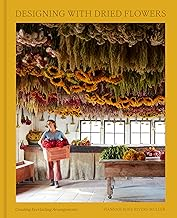
Designing with Dried Flowers, by Hannah Rose Rivers Muller, is based on the extensive experience of the author growing, harvesting, drying, and arranging flowers on her 400 acre, organic farm in northern California. She shares the thoughts, experiences, and techniques she developed as she started and built up her dried flower business in the Capay Valley. Focusing on sustainability and mindfulness, her experience reflects the field to vase philosophy she has helped pioneer.
The book is divided into three main sections: sourcing and drying flowers, recommended flowers for drying by season, and how to make dried arrangements. The first section gives detailed directions on harvesting, drying and storing flowers. The discussion describes tools and materials, how to create a good drying area, and ways to keep the dried flowers in top condition for use at a later time.
The recommendations for seasonal flowers is especially valuable. It briefly describes the flowers of each season that will retain their petals and color when dried. We learn that in spring, anemones, larkspur, and short stemmed ranunculus are favored focal flowers, while feverfew, lavender, safflower, snapdragon and yarrow are good fillers. Various grasses, grains, and pods add special interest. Likewise, summer and fall have their special focal flowers, fillers, accent material, and foliage.
The section on dried arrangements begins with a list of tools, color theory, and techniques for breaking down large flowers into manageable parts and continues with directions for a bud vase, frog arrangement, braid, centerpiece, crown, mixed bouquet, mini bouquet, strands, and wreaths. The section on wreaths is outstanding and is especially full of ideas and examples. Each arrangement is accompanied by a list of materials and tools, step by step directions and several photographs of the arrangement in progress as well as completed. A problem arises, however, because the directions are a bit vague and not closely coordinated with the photographs. Perhaps for an experienced designer this is not a problem.
Sparkling photographs of dried flowers illustrate the plant material grown and used by the author. Sometimes the colors are so vivid it is hard to believe they are true to life. Yes, the author is drying flowers in an ideal environment which is hot and dry but since most readers will probably face more humid and cooler conditions the results for them may be less than expected. Regardless of the color issue, the photographs bring out the subtle textures of the plant material and are beautiful to the eye and the imagination.
To buy Designing with Dried Flowers from Amazon.com, click here.