
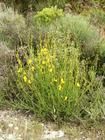
Known as rush broom and weaver’s broom, this flowering deciduous shrub is native to southwestern Europe, the Mediterranean, and the Azores where it grows on dry, sandy, sunny sites. It is a member of the legume family, Fabaceae, that also includes pea, black locust and mimosa, and is closely related to other brooms in the genera Cystius and Genista. Plants grow 6-13′ tall and have numerous, grooved, rush-like stems that are evergreen. The bright green leaves are up to 1″ long, sparsely produced, and last for month but are sometimes are absent. From summer into fall terminal loose racemes up to 18″ long of bright yellow fragrant flowers appear. Each flower is about 1″ long and is followed by a hairy flat seed pod 3-4″ long. Spanish broom tolerates drought and seaside exposure so is an excellent choice for xeriscapes, seaside and Mediterranean gardens. It is a vigorous plant, however, and is considered invasive and a noxious weed in California, Oregon and Hawaii. The genus name, Spartium, is from the Greek word sparton, a kind of grass used for weaving and rope making. The specific epithet, junceum, means rush-like and refers to the shoots that lightly resemble those of the genus Juncus, or rush.
Type: Deciduous shrub
Outstanding Feature: Yellow flowers
Form: Rounded
Growth Rate: Rapid
Bloom: Terminal racemes up to 18″ long of fragrant, yellow pea-like flowers from spring to fall; year round in very mild climates
Size: 6-13′ H
Light: Full sun
Soil: Average to lean, sandy, dry, well-drained
Hardiness: Zones 8-10
Care: Prune in spring to promote bushiness.
Pests and Diseases: None of significance
Propagation: Seed, softwood cuttings
Photo Credit: Wikipedia