
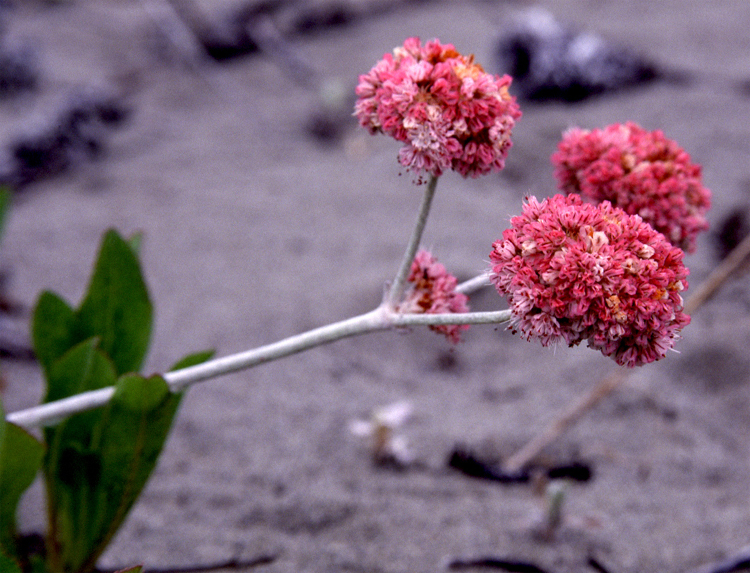
Native to coastal bluffs and scrub from Washington to central California, this herbaceous perennial is a member of the knotweed family, Polygonaceae, that also includes rhubarb, dock and sea grape. The plant forms a mat that is variable in size and is usually about 1′ tall but may be 2′ tall or more in sheltered locations. The stems and leaves are usually densely or lightly covered with white woolly matted hairs although the upper sides of leaves are sometimes hairless. The blue-gray, spoon-shaped leaves are ovate, 2″ long, and 1.5′ across. Throughout the year, globose clusters up to 6″ across appear well above the leaves on slender, branched, leafless stalks. The flowers have white to dark pink petals with protruding stamens, and mature to rust color. Attractive to butterflies, bees and other pollinators, the plant also provides larval food for two butterflies. Seaside buckwheat is valued for bank stabilization, drought and salt tolerance, and as a ground cover, as well as use in native plant, seaside, wildlife, pollinator, butterfly, and bee gardens. The genus name, Eriogonum, comes from the Greek words, erion meaning wool, and gony meaning knee and refers to the downy hairs on the nodes of the stems. The specific epithet, latifolium, comes from the Latin words latus, meaning wide, and folium, meaning leaf.
Type: Herbaceous perennial
Bloom: Globose clusters up to 6″ across of white to dark pink flowers with protruding stamens, year round
Size: 1.7 – 2.3′ H x 3′ W
Light: Full sun on coast, part sun inland
Soil: Rocky to sandy, dry to medium moist, well-drained, acidic to neutral
Hardiness: Zones 8-11
Care: Low maintenance
Pests and Diseases: None of significance
Propagation: Seed
Companion Plants: Sand verbena (Abronia spp), Ceanothus gloriosus, Lupinus spp. , bluff lettuce (Dudleya farinosa)
Photo Credit: Gordon Leppig & Andrea J. Pickart Wikimedia Commons
 Karen Meyers