
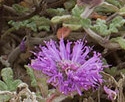
This rare herbaceous perennial is endemic to California where it grows on unstable sand dunes along the coastline of San Luis Obispo and northern Santa Barbara Counties. It is a member of the deadnettle family, Lamiaceae, that also includes mint, lavender and beebalm. The plant grows up to 1.6′ tall with a rhizomatous root stock and forms a woolly mound or mat of stems that are up to 20″ long and carry clusters of fleshy, waxy leaves that are sometimes woolly. The leaves are .4-2″ long and have twisted surfaces and margins. From spring into fall, terminal clusters of purplish pink flowers in a cup of hairy, purplish to straw-colored bracts appear. The flowers are very fragrant and attract butterflies and other pollinators. Crisp dune mint is a good choice for seaside, native plant, wildlife, butterfly, bee, and hummingbird gardens. The genus name, Monardella, is the diminutive of Monarda, the genus name for beebalm and honors Nicolás Bautista Monardes (1493 –1588) Spanish physician and botanist.
Type: Herbaceous perennial
Bloom: Terminal clusters of purplish pink flowers in a cup of hairy, purplish to straw-colored bracts, spring into fall
Size: 1-1.6″ H x 2-3′ W
Light: Full to part sun
Soil: Sandy, dry, to medium moist, well-drained
Hardiness: Zone 10
Care: Low maintenance
Pests and Diseases: None reported
Propagation: Seed, division (unverified)
Companion Plants: Beach evening primrose (Camisonia cheiranthifolia), sand verbena (Abronia maritima)
beach morning glory (Calystegia soldanella)
Outstanding Selections: ssp. crispa