
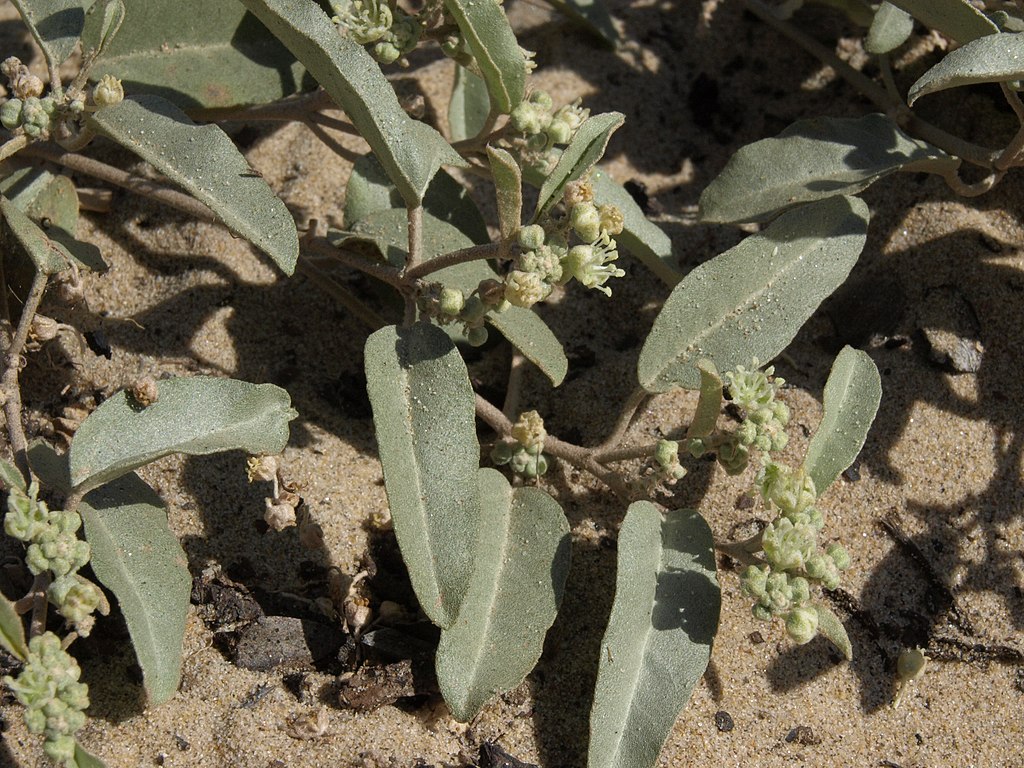
Also known as desert croton, this short lived evergreen perennial or subshrub is native to the deserts and coastlines of California, Nevada, Utah, Arizona, and Baja California, where it grows on sandy soils, dunes, and washes. It is a member of the spurge family, Euphorbiaceae, that also includes poinsettia, castor oil plant, rubber plant. The plant grows 1-3′ tall and has a woody base and loosely branched stems with oblong, 2″ long leaves. The stems and leaves are grayish green due to tiny, star-shaped hairs that protect the plant from grazers, wind, heat, and water loss. From spring into fall, racemes of inconspicuous, greenish-white male and female flowers appear in the upper leaf axils of different plants. The flowers are about 1/8″ across, lack petals but have a small cup-like calyx with 5 lobes. The fruit is a spherical, 3-chambered capsule, each chamber bearing a single seed. The genus name, Croton, comes from the Greek word krotōn meaning sheep tick and refers to the shape of the seeds. The specific epithet, californicus, is the Latinized form of the name of one of the states where the plant is native.
Type: Perennial herb to subshrub
Outstanding Feature: Foliage
Form: Open, lacy
Growth Rate: ?
Bloom: Racemes of inconspicuous greenish-white male and female flowers on different plants fro sping to fall
Size: 1-3′ H x 1-5′ W
Light: Full sun
Soil: Sandy, dry to medium moist, well-drained
Hardiness: Zones 9-10
Care: Low maintenance
Pests and Diseases: None of signficiance
Propagation: Seed (unverified)
Selections:
var. mohavensis
var. tenuis
Photo Credit: Jim Morefield Wikimedia Commons