
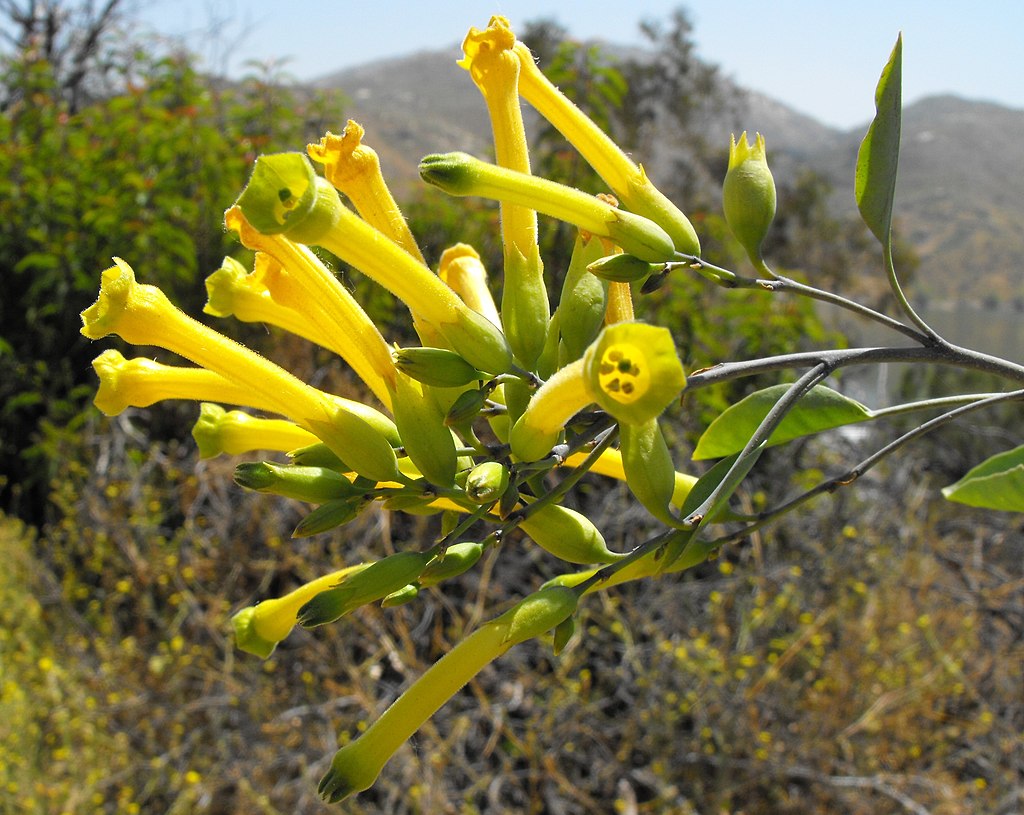
Also known as mustard tree, juanloco, and palo loco, this short lived, evergreen shrub or small tree is native to South American from central northwest Argentina to southern Bolivia. It has colonized, however, in a wide variety of habitats around the world and is considered a weed and invasive in some places including parts of the US. Tree tobacco is a member of the nightshade family, Solonaceae, that also includes tomato, eggplant, and petunia. The plant grows up to 20′ tall and has many arching or drooping branches and bluish green, oval, succulent leaves that are stalked, 2-10″ long, and covered with a powdery bloom. From spring into fall, large, branched clusters of greenish yellow to yellow or red flowers appear that are attractive to hummingbirds and other pollinators. Each tubular flower is up to 1.5″ long and and consists of 5 petals with lobes at the top. The egg shaped fruit is a 1″ long capsule that is surrounded by a papery calyx and contains numerous tiny brown seeds with textured coats. A single plant can produce 10,000-1,000,000 seeds per year, with seed viability nearly 100% , so has great reproductive potential. Although the plant is described as “spindly” and can out-compete native species to become weedy and invasive, it has often been used as an ornamental because it is drought resistant, tolerates of a wide range of environmental conditions, and its flowers attract hummingbirds. Unfortunately, however, all parts of the plant are considered extremely poisonous. The genus name, Nicotiana, honors Jean Nicot (c.1530-1600) a French ambassador to Portugal, who sent tobacco seeds and powdered leaves from Lisbon to France. The specific epithet, glauca, comes from the ancient Greek word γλαυκός (glaukós), meaning blue-green, or blue-grey and refers to the powdery bloom on the leaves.
Type: Evergreen shrub or small tree
Outstanding Feature: Flowers, tolerance to variable conditions
Form: Straggly
Growth Rate: Rapid
Bloom: Clusters of yellow tubular flowers from spring until fall
Size: Up to 20′ H
Light: Full sun
Soil: Rich, moist, well-drained
Hardiness: Zones 7-10
Care: Restrict seed dispersal
Pests and Diseases: None of significance
Propagation: Seed
Photo Credit: Stickpen Wikimedia Commons