
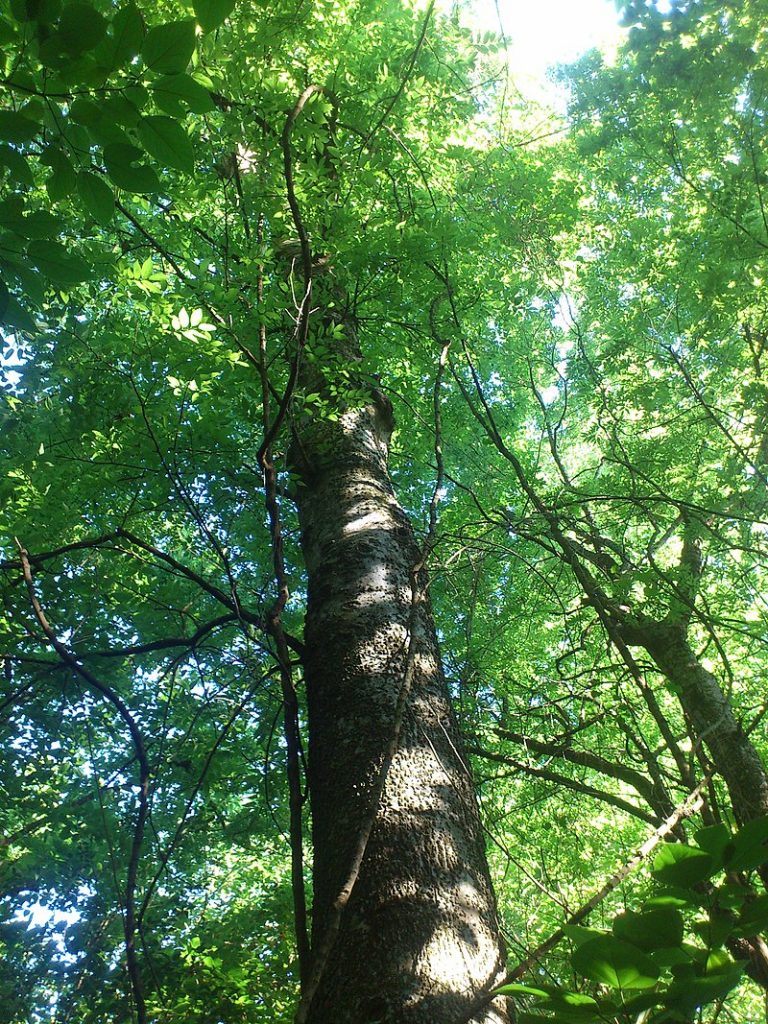
Also known as hackberry, this deciduous tree is native to lowlands of eastern US west to Texas and south to northeastern Mexico where it usually grows along streams and in moist soils on floodplains. It is a member of the hemp family, Cannabaceae, that includes marijuana and hop. The tree grows up to 70′ and has a single trunk with smooth light gray to brown bark interrupted by corky warts. The ovate to lanceolate, light green leaves are 1-6″ long and have serrated margins. In climates cooler than USDA Zones 8, the leaves may turn an attractive yellow in the fall. The inconspicuous greenish-white flowers emerge singly or in clusters at the leaf axils as the leaves appear in the spring. They give way to a round, fleshy drupe that is 1/3″ across, orange turning dark purple when ripe, and attractive to birds and small mammals. In addition, the trees are larval host plant for several butterflies and the wood is valued by the lumber industry. Sugarberry provides excellent shade and is tolerant of urban pollution and soil compaction so could be useful in urban landscapes. The genus name, Celtis, is an ancient Greek name for a tree with sweet fruit. The specific epithet, laevigata, is the Latin word meaning smooth or polished.
Type: Deciduous tree
Outstanding Feature: Shade
Form: Rounded vase crown
Growth Rate: Rapid
Bloom: Inconspicous greenish white flowers in spring
Size: 50-70′ H x 50-60′ W
Light: Full sun; tolerates partial shade
Soil: Prefers fertile, moist, well-drained soil but tolerates, sand to clay, dry to wet soil, periodic flooding, and salt spray
Hardiness: Zones 6-9
Care: Prune when young to encourage strong structure.
Pests and Diseases: Generally healthy but susceptible to nipple gall, trunk rot, leaf spots, mistletoe, mistletoe, and witches’ broom. Especially sensitive to mechanical injury that leads to trunk rot.
Propagation: Seed
Comments: Tolerant of urban pollution and soil compaction; leaf and fruit litter can be a problem
Photo Credit: Toshea2006 Wikimedia Commons