
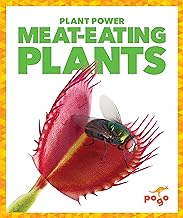
Mari Schuh’s book, Meat-Eating Plants, introduces young readers to 6 plants that obtain their food from insects or small animals. Written for children 6-9 years old in grades 2-3, the book combines scientific information with large detailed photographs to educate and encourage an appreciation of the diversity and uniqueness of plants. Suggestions are given for using the book to introduce children to nonfiction features while practicing reading for informational content.
The meat-eating plants are divided into 3 groups and presented according to the way they get their prey; luring, sticky traps, and snap traps. Each entry describes why the prey comes to the plant and how the plant utilizes the animal for nutrition. Additional information is given on various alternate food sources, and the habitat of the plant. A full page photograph of the plants and their prey illustrate the text. We learn that prey may drown in the pool of a pitcher plant, sticky leaves of sundew plants bend and fold around wiggling prey, and the sweet smell of nectar lures prey into cobra lilies. Did you know that the leaves of butterworts make sticky glue when the prey lands on them? That the bristles of the waterwheel plant snap shut on underwater insects? Or that tiny trigger hairs on the inner lobes of Venus flytraps cause the lobes to snap closed on an insect in less than one second? An activity about digestion of food, a glossary, Index and list of additional resources are included in end pages.
The text is written in short simple sentence and avoids overly technical terms while introducing simple ones like glands, nectar, and enzymes. Considering that there are about 600 kinds of meat-eating plants, a larger selection of plants included in the book would be a positive especially some that ate animals like frogs, lizards and birds.
To buy Meat-Eating Plants from Amazon, click here.