
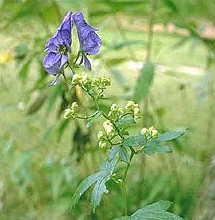
Also known as wolfbanes, leopard’s bane, devil’s helmet, or blue rocket, these herbaceous perennials are native to the mountainous parts of the Northern Hemisphere in North America, Europe, and Asia, where they grow in the moist, well-drained soils of mountain meadows. They are a member of the buttercup family, Ranunculaceae, that also includes delphinium, anemone, and hellebores. Plants usually grow at least 3′ tall but may be prostrate, reclining or climbing. The leaves are dark green, and usually deeply palmately lobed or divided, with toothed margins. The flowers are usually carried in erect terminal racemes or panicles up to 8″ long from mid-summer to early fall and are blue to purple, occasionally white or yellow. Each flower is up to 1″ long and consists of five sepals and two to ten petals. One of the sepals forms a helmet-like structure that hides the two upper, larger petals with nectaries in their spurs. The remaining petals are small, reduced to scales, or non-forming.
Monkshood is easy to grow in cool, organically rich, consistently moist, well-drained soil and do not tolerate wet soil. Although they may be grown in full sun in the northern part of their range they need afternoon shade elsewhere. Plants do best when their roots are cool and moist but the majority of the leaves are exposed to sun. They do not tolerate high heat and humidity. Monkshoods are generally healthy but are susceptible to damage by a variety of fungi if grown in humid and/or overly wet conditions. Propagated is by divisions of the root or by seeds.
The derivation of the genus name, Aconitum, is disputed but may come from a Greek word ἀκόνιτον (akoniton) which may come from the Greek word ἀκόν (akon) meaning dart or javelin, the tips of which were dipped in poison.
All parts of the plant contain highly poisonous alkaloids, especially the roots. Plant away from vegetable gardens and children’s play areas.
Photo Credit: National Park Service
The environmental conditions in New England have resulted in 1 native species of monkshood there but it is native to other places too.
Wild Monkshood (Aconitum uncinatum)
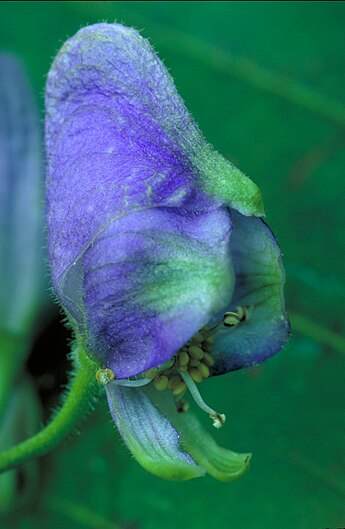
The slender, flexible stems may be erect or vine-like and gain support by growing on other plants. The palmate leaves are up to 6″ wide and long, and have 3-5, sometimes up to 9, lobes. The hooded flowers appear in terminal clusters and are 1″ long, and usually deep purple or purplish-blue, occasionally white. They attract pollinators including a variety of butterflies, moths and bees.
Alternate Name/s: Southern Blue monkshood
Native Range: New Hampshire as well as places in the Midwest, Southeast, and Mid-Atlantic
Habitat: Moist to wet soils in forests along streams and in clearings
Type: Perennial
Height: 3-6′
Bloom Time: Late summer to mid fall
Bloom Color: Purple
Light: Dappled shade
Soil: Cool, humusy, consistently moist, well-drained, slightly acidic
USDA Hardiness Zones: 4-9
Photo Credit: Wikipedia
The New England area includes Maine, New Hampshire, Vermont, Massachusetts, Rhode Island and Connecticut. The area offers diverse geography with rivers, lakes, forests, mountains, and coast lines on both the Atlantic Ocean and Long Island Sound. It has four distinct seasons that provide environmental conditions for at least one native monkshood. The winters are long, cold, and heavy snow is common from December to February. Summer is short with temperatures between 80 and 85 F. Precipitation averages about 45″ as rain and 60-90″ as snow.