
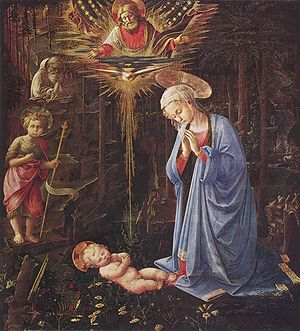
Mary is usually shown in Medieval and Renaissance art with most of her hair covered by a veil or scarf as was the Jewish custom of her time. Women, especially when they were married, were expected to cover their hair in public and religious settings as an expression of their devotion and modesty as St. Paul wrote in 1 Corinthians 11. Mary with her hair covered became a symbol of modesty, humility, and obedience to God’s will. To the medieval mind, the fronds of the maidenhair fern resembled the tresses of Mary. The exact species of fern is not known with certainty but the cosmopolitan Venus fern (Adiantum capillus-veneris ) is a likely possibility as it is native to much of Europe, and the Levant as well as North America, western Asia and Australasia.
Picture by Filippo Lippi, 1459

Also known as Southern maidenhair fern, black maidenhair fern, and maidenhair fern, this deciduous fern is a member of the plant family, Pteridaceae, that includes 1150 species of ferns in about 45 genera. Plants grow 8-18″ tall and have bi-pinnate and tri-pinnate fronds with bright green, fan-shaped pinnae on wiry black stems that arch gracefully downward. Sori (clusters of spore cases) appear in summer on the undermargins of the pinnae. The plant is clump forming and has a creeping rhizome. It may go dormant in summer if water is lacking.
Photo Credit: Wikipedia
The genus name, Adiantum, comes from the Greek work meaning unwettable and refers to the fact that the fronds shed water. The specific epithet, capillus-veneris, are the Latin words meaning hair, and of Venus, respectively.
Maidenhair fern likes shade to part shade in average, moist, well-drained, neutral to alkaline soil in USDA Hardiness Zones 5-8. Plants are healthy and have no significant pests or diseases. Propagation is by spores and division.
 Karen
Karen