
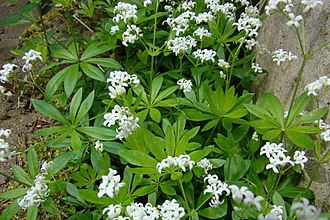
Sweet woodruff has been valued since the Middle Ages for its medicinal and aromatic properties. It was used to treat various ailments from wounds to heart problems, and to freshen the scent of linens as well as homes and public spaces in a time when bathing was limited. The lace-like pattern created by its dainty star-like white flower and delicate whorled leaves, was associated by early Christians with the embroidery of Virgin Mary that was part of her role as a wife and mother. The white color of the flowers was thought to be a symbol of Mary’s purity and innocent and heightened the association between her and sweet woodruff.
Photo credit: Wikipedia
Also known as sweetscented bedstraw, this herbaceous perennial is native to Europe, Asia and northern Africa. It is a member of the coffee family, Rubiaceae, that also includes gardenia and Pentas. Plants grow 6-12″ high and have slender, weak green stems carrying whorls of 6-9 lance-shaped, dark green leaves that are 3/4 to 2″ long. When crushed or cut the leaves emit a scent like freshy mown hay. In spring, cymes of small white 4-petaled flowers appear well above the foliage and are followed by round, 1″ wide fruits covered with hooked bristles.
The genus name, Galium, is from the Greek word γάλα (gala) meaning milk, and refers to the use of one species in cheese making. The specific epithet, odoratum, is the Latin word meaning fragrant and refers the aromatic quality of the leaves.
Sweet woodruff likes part to full shade, in average, moist to wet, well-drained, acidic soil in USDA Hardiness Zones 4-8. Plants have no significant diseases or pest and can be propagated by seed or division.
 Karen
Karen