
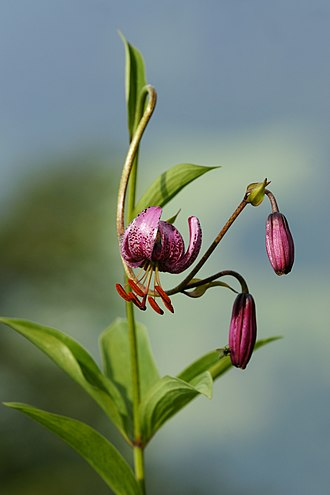
The tears of Mary are linked to several plants including lily of the valley, larkspur, and spiderwort, as well as Turk’s cap lily. Tradition tells us that the tears of Mary as she wept at the crucifixion of Jesus turned into flowers but exactly what flowers is uncertain. The link between Mary and Turk’s cap lily is suggested by its nodding flowers with recurved petals that resemble a hanging head and might symbolize sorrow, grief and humility, all associated with Mary.
Photo Credit: Wikipedia
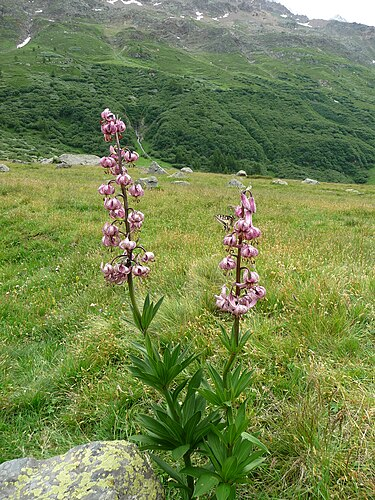
Known since 1568, this herbaceous perennial is a native of Europe and Asia. It is a member of the Liliaceae plant family that also includes tulips, fritillaries, and Quamash. Plants grow 3-4′ tall from a bulb and have whorls of lance-shaped leaves up to 6″ long. In summer, the top half of the stem produces up to 50 flowers that are white to pink, sometimes with maroon spots, very fragrant and attractive to butterflies and other pollinators. Each flower is 2-3″ across and has 6 recurved petaloid tepals. Plants resent being moved and may sulk for the first year.
The genus name, Lilium is the Latin name for lilies. The specific epithet, martagon may come from Ottoman Turkish word mārtağān, a special kind of turban adopted by Sultan Muhammed, and refers to the appearance of the flowers.
Turk’s cap lilies like rich, consistently moist, well-drained, slightly alkaline soil and full sun to partial shade in USDA Hardiness Zones 3-7. Unlike most lilies they do well in partial shade, grow taller, and produce more blooms on each stem. They are generally healthy, have no pests or diseases of significance but do not transplant well. Propagation is by division of bublets.
Photo Credit: Wikipedia
 Karen
Karen