
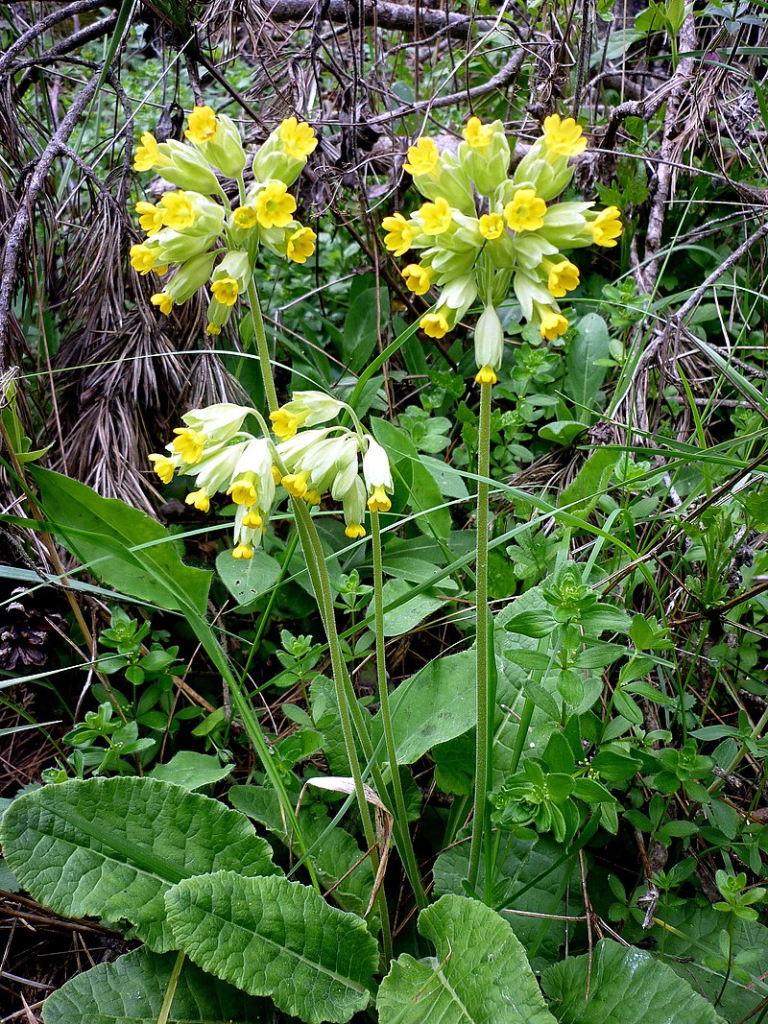
Primula veris is known as Our Lady’s Keys due to the appearance of its flower clusters and Christian legend. Early Christians thought that the drooping flower clusters resembled an old-fashion bunch of keys. According to medieval folklore, the keys of heaven belonged to Mary (or St. Peter in some versions) and when she/he accidently dropped them to Earth, cowslips sprung up where they landed. According to Christian tradition, keys represent the power to open the gates of heaven and thus symbolize access to paradise. Cowslip’s use in folk medicine further linked the plant to Mary and her caring, nurturing and protective attributes.
Native to temperate Europe and western Asia, this evergreen or semi evergreen herbaceous perennial is a member of the primrose family, Primulaceae, that also includes scarlet pimpernel. Plants form a 4″ tall basal rosette of oval to lance-shaped leaves. The leave are 3-6″ long, crinkled and have irregularly-toothed margins and soft-hairy undersides. Clusters of 1-30 nodding, yellow flowers appear on upright stems 6-8″ tall from mid to late spring. The flowers are funnel shaped, .5-.75″ long, and may be single or double. They have red spots on their petals and a fresh fragrance that attracts butterflies. Plants go dormant in hot weather.
The genus name, Primula, is the diminutive form of the Latin word, primus, meaning first. The specific epithet, veris, is the Latin word meaning of spring so the whole botanical name, Primula veris, means little early one of spring referring to its diminutive size and bloom time.
Cowslip prefer part shade and humusy, consistently moist, well-drained soil in USDA Hardiness Zones 3-8. It is generally healthy and has no significant pests or diseases. Propagation is by seed and plants readily selfseed.
 Karen
Karen