
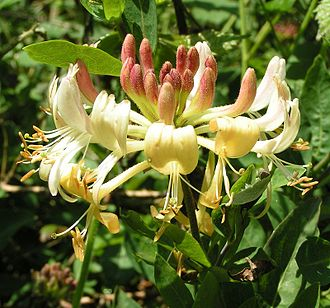
The link between woodbine and the Virgin Mary rests on the physical characteristics of the plant and Christian legend. The tubular flowers resemble slender fingers and may symbolize Mary’s gentle touch and blessings. The twining, clinging nature of the plant may suggest Mary’s loving embrace, unwavering faith and role as protector. One legend tells us that woodbine grew around the feet of Mary as she stood by the cross offering her comfort and support in her sorrow. Another story tells us that woodbine growing on a tree hid a young woman fleeing persecution. In a similar fashion, woodbine is said to have sheltered the Holy Family during the Flight into Egypt as they fled from Herod.
Also known as European honeysuckle, this twining deciduous shrub has a vine-like growth habit. It is native to woodlands, hedgerows and scrublands of Europe, North Africa and western Asia and is a member of the honeysuckle family, Caprifoliaceae, that also includes weigelia, snowberry, and scabious. Plants grow 10-20′ tall/long and have thin stems that are brown, purple or red. The opposite, dark green leaves are ovate to obovate, 1-3″ long, and have a conspicuous vein down the center of the top side. Terminal whorled clusters of tubular, two-lipped flowers 1-2.5″ long appear in late spring and periodically through summer. The buds may be flushed with pink or red but open to show a creamy white interior that turns yellow with maturity. The flowers are fragrant, more so at night than during the day, and attract butterflies and other pollinators. The fruit is a red berry that matures in the fall.
The genus name, Lonicera, honors Adam Lonitzer (1528-1586), a German botanist and author. The specific epithet, periclymenum, honors Περῐκλῠ́μενος (Periklymenon), an Argonaut in Greek mythology who had the ability to change his shape, and refers to way the flowers change color with maturity.
Woodbine likes average, medium moist, well-drained soil and dappled shade to part shade to sun with afternoon shade in hot climates. It is hardy in USDA Hardiness Zones 5-9 and grows best in cool climates with its roots in the shade. Plants are generally healthy but can suffer damage from powdery mildew, leaf spot, aphids, and scale. Propagation is by layering, seed, and stem cuttings.
 Karen
Karen