
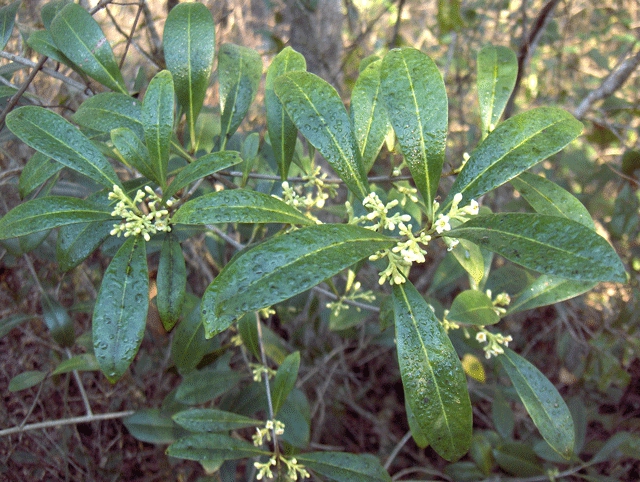
Also known as wild olive and devilwood, this evergreen shrub or small tree is native to the coastal forests along the Atlantic Ocean and the Gulf of Mexico from Virginia to Texas. It is a member of the olive family, Oleaceae, that also includes ash, jasmine, and privet. The plant usually grows up to 25′ tall but may reach 36′ tall, and has a short trunk branching near the ground, and gray-brown bark with warty lenticels. The simple, opposite, leathery leaves are 2- 4.5″ long, elliptical, and have smooth to slightly wavy margins. They are dark green on top with a rusty underside and turn yellow-green in the fall if the plant is grown in the sun. In early spring, branched clusters of urn-shaped, creamy white flowers appear in the leaf axils. They are .4″ long and have a strong fragrance. The fruit is a dark blue drupe .24-.59″ across with a single seed. It matures in the fall and is attractive to birds and small mammals. American olive tolerates drought, occasional flooding, salt spray, and deer. It is a good choice for hedge or screen or use in wildlife, fragrance, and seaside gardens. The origin of the genus name, Cartrema, is uncertain. The specific epithet is the Latinized name for America, the area where the plant is native.
Type: Evergreen shrub or small tree
Outstanding Feature: Fragrant flowers
Form: Oval
Growth Rate: Slow
Bloom: Creamy white clusters of fragrant flowers in early spring
Size: 15-25′ H x 10-15′ W
Light: Full sun to part shade; tolerates almost deep shade
Soil: Average, medium moist, well-drained but tolerates some drought and occasional flooding
Hardiness: Zones 6-9
Care: Low maintenance
Pests and Diseases: None of significance
Propagation: Seed (2 years to germination); tip cuttings
Photo Credit: Homer Edward Price Wikimedia Commons