
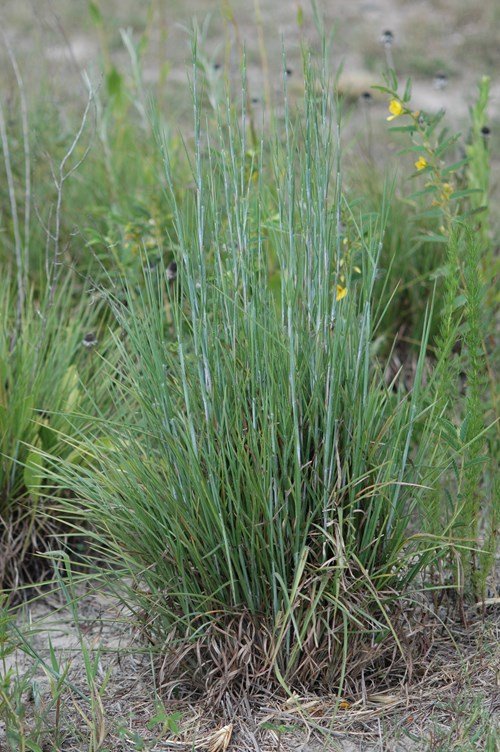
Also known as dune bluestem, seaside little bluestem, and shore little bluestem, this warm season perennial grass is native to dunes on the Atlantic and Gulf seacoast from Massachusetts to Texas. It is a member of the grass family, Poaceae, that also includes rice, corn, and bamboo. The plant grows as a clump 1-2′ tall and has coarse blue-green stems with purplish basal leaves that turn bronze with age. The narrow leaves are 4-10″ long and smooth, but frequently hairy near the base. The lowermost parts of plant are usually buried in sand where the stems root at the nodes. From late summer to mid fall, narrow racemes of purple-bronze flower spikelets appear well above the foliage and are followed by fluffy, silvery-white seed heads. Coastal little blue stem grass is tolerant of heat, drought, salt spray and nutrient poor soils but not flooding or moist, fertile soil. It provides cover for ground birds and small mammals and is valued for use in coastal gardens as well as for erosion control on frontal back dune and secondary dune systems. The genus name, Schizachyrium, ancient Greek words σχίζειν (schizein), meaning to split, and ἄχυρον (achyron), meaning chaff referring to either the glume or the toothed lemmas of the grass inflorescence. The specific epithet, littorale, comes from the Latin word litus meaning shore and refers to the favored habitat of the plant.
Type: Warm season perennial grass
Bloom: Narrow racemes of purple-bronze flower spikelets in late summer to mid fall
Size: 1-2′ H x 1-2′ W
Light: Full sun
Soil: Sandy, dry to medium moist, well-drained; highly salt tolerant but not tolerant of flooding
Hardiness: Zones 4-9
Care: Cut to the ground in late winter to early spring
Pests and Diseases: None of significance
Propagation: Division, seed
Companion Plants: Beach evening primrose, dune sunflower, seaside goldenrod
Photo Credit: Larry Allain USGS