
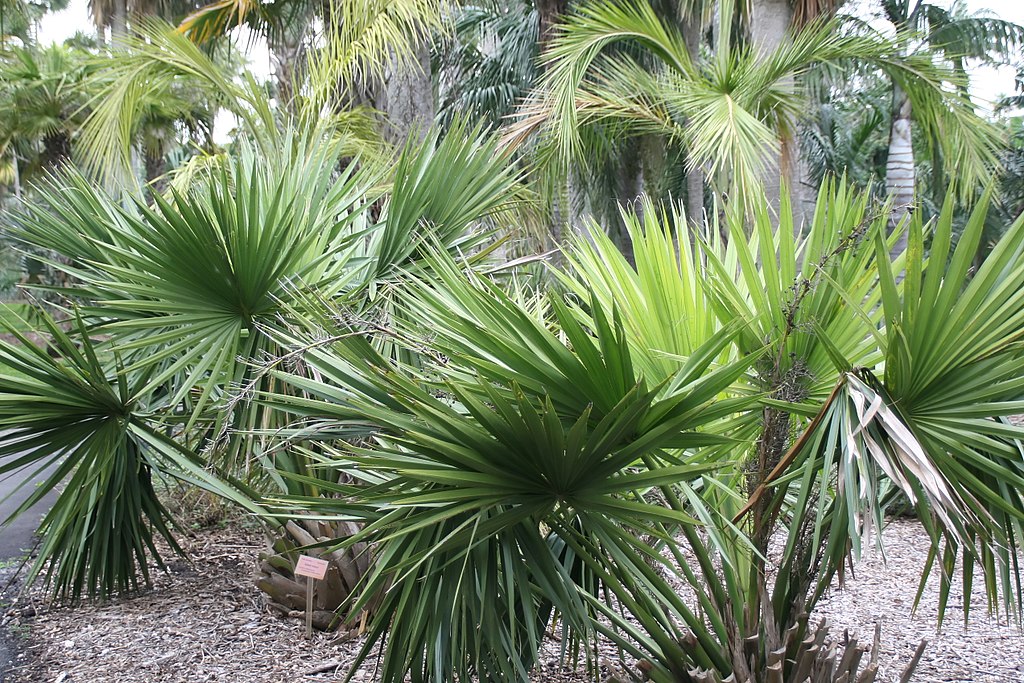
Dwarf palmetto, also known as swamp palmetto, is native to the deep southeastern and south-central United States and northeastern Mexico where it grows in a variety of habitats, including maritime forests, swamps, ravines, bottomlands, and floodplains. A member of the palm family, Arecaceae, the plant grows up to 10′ tall and may have a short trunk up to 12″ in diameter or a subterranean trunk and appear trunkless. Large fan-shaped, blue green to dark green leaves 1-5′ long are produced on smooth long petioles. Each leaf is palmately divided into 30- 40 leaflets that are joined for over half their length. In summer, large compound panicles up to 6′ long appear beyond the leaves and carry fragrant, small, yellowish flowers. The fruit is a single seeded, black drupe about 1/2″ long and attractive to birds and small mammals. Dwarf palmetto is drought and moderately salt tolerant, and brings a tropical look to a garden. It may form suckering colonies in damp soil and is useful in a rain garden. The genus name, Sabal, is of uncertain origin but may be from be from a South American or Mexican name. The specific epithet, minor, is the Latin word meaning smaller.
Type: Evergreen tree
Outstanding Feature: Foliage
Form: Rounded
Growth Rate: Slow
Bloom: Large compound panicles up to 6′ long with fragrant, small, yellowish flowers in summer
Size: 4-10′ H x 4-8′ W
Light: Part shade to full sun
Soil: Average, consistently moist, well-drained; drought tolerant, moderately salt tolerant
Hardiness: Zones 7-10
Care: Mulch in winter in colder part of range
Pests and Diseases: None of significance
Propagation: Seed
Outstanding Selections: ‘Savannah Silver’
Photo Credit David J. Stang Wikimedia Commons