
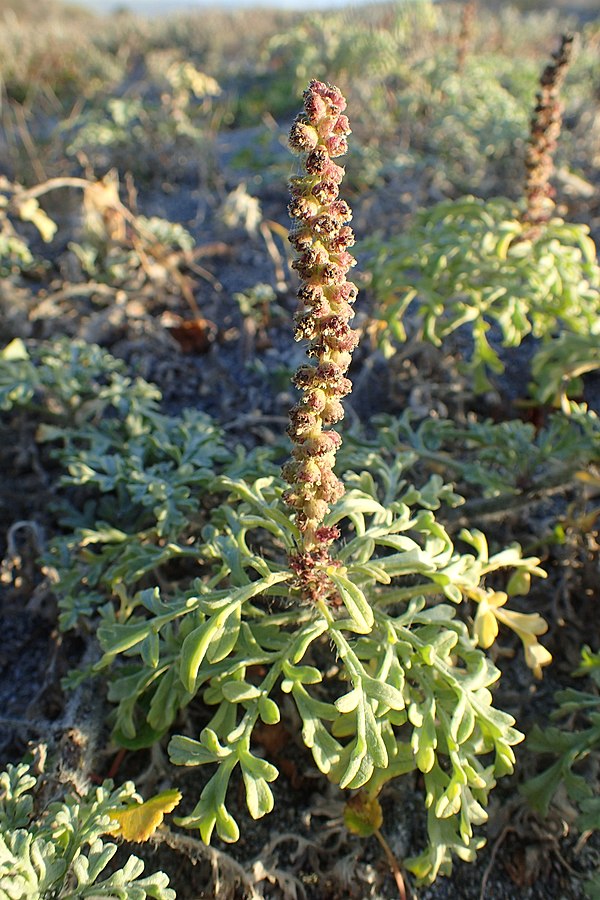
Also known as silver beachweed and silver bur ragweed, this herbaceous perennial is native to maritime strand beaches and dunes of western North America from Baja California to Alaska. It is a member of the aster family, Asteraceae, that also includes sunflower, yarrow, and lettuce. The plant grows up to 4′ tall from a tap root and has succulent stems that are hairy, longitudinally ridged, and sprawl to form a mat up to 10′ wide. The woolly, silver-green leaves are variable in size and shape; they may be .5-2″ long, oblanceolate to elliptical to triangular, and toothed, or pinnately lobed or divided. In summer, yellow green male and female flowerheads appear on flowering stems of the same plant. The male flowerheads are at the tip of the stems with female flowerheads clustered beneath them. Each male flowerhead is cup-shaped, about 4 to 8 mm wide and contains 8 to 50 tiny pale florets. Each female flowerhead contains a single tiny floret that lacks petals and develops into an ovoid, bur-like fruit. The fruit is almost 1/2″ wide and is covered with sharp spines. Beach bur is tolerant of drought, salt spray, and is valued for use in stabilizing beaches and restoring sand dunes. The genus name, Ambrosia, is from the ancient Greek word ἀμβροσία (ambrosía) meaning immortality. The specific epithet, chamissonis, honors German botanist and poet Adelbert von Chamisso (1781-1838).
Type: Herbaceous perennial
Bloom: Green to yellow male and female flowerheads on the same plant in summer
Size: 4′ H x 10′ W
Light: Full sun
Soil: Sandy, dry to medium moist, well-drained
Hardiness: Zones 9-10
Care: Low maintenance
Pests and Diseases: Leafhopper
Propagation: Seed, layering, division
Companion Plants: Sand verbenas (Abronia spp), Beach evening primrose (Camissonia cheiranthifolia), saltgrass (Distichlis spicata)
Photo Credit: Krzysztof Ziarnek, Kenraiz Wikimedia Commons