
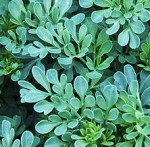
 Also called herb of grace, rue is an evergreen mounding subshrub native to the Balkan Peninsula where it grows on dry hillsides, often on limestone. The ancient Greeks used rue to stimulate the uterus and nervous system, and the Romans used it to improve eyesight. Growing up to 3’ tall, the plant has a woody base and blue-green pinnately compound leaves 3-5” long with oblong to spatulate leaftlets. The leaflets are fleshy, dotted with glands, and are very aromatic when crushed. The dull yellow flowers have 4-5 petals, are ¾” across, and appear in flattened corymbs in early summer. Plants are usually grown for the attractive foliage and are popular in herb and rose gardens.
“Woe to you Pharisees, because you give God a tenth of your mint, rue and all other kinds of garden herbs, but you neglect justice and the love of God. You should have practiced the latter without leaving the former undone.”
Plants like full sun to partial shade and average to lean, moist to dry, well-drained soil in USDA Hardiness Zones 4-9. They are generally healthy but may suffer from root rot is wet soils or hot climate. Propagation is by seed and terminal cuttings in late summer and early fall
The genus name, Ruta, may be related to the Greek word reuo meaning set free and refers to the healing power of the plant. The specific epithet, gravolens, probably is related to the Latin word gravis meaning heavy, and refers to the scent.
 Karen Meyers