
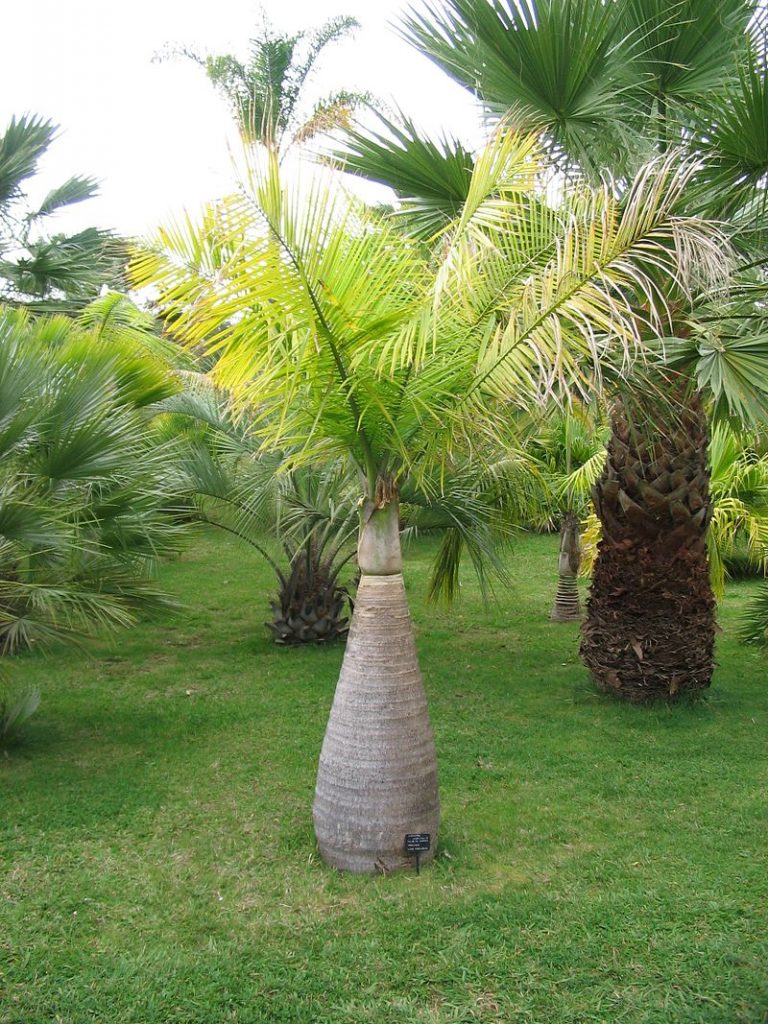
This evergreen tree is also known as bottle coco, champagne palm and pig nut palm, and is endemic to Round Island off the coast of Mauritius where it grows in well-drained sandy soils of upland forests and coastal savannas. A member of the Palm family, Arecaceae, the plant grows up to 20′ tall and has a single, smooth, pale gray to almost white trunk that is bulbous at the base when young but be comes more elongated and slender with maturity. Four to eight arching pinnate leaves arise from a smooth green crownshaft that is 2-3″ long, located at the top of the trunk, and may have a reddish tinge when young. The dark green glossy leaves are carried on 10″ long petioles, are up to 12′ long, and consist of 140 lanceolate leaflets that are 2′ long and arranged in 2 upward pointing rows. Small white male and female flowers are produced on heavily-branched inflorescences up to 3′ long, located on the trunk just below the crownshaft. The fleshy, single seeded fruit is oval, about 1.5″ long, and olive green turning black when ripe. Although endangered in its natural habitat, bottle palm is grown widely as an ornamental and is a good choice for containers, as house plants, as specimens, and in seaside gardens. The genus name, Hyophorbe, comes from the Greek words hyo meaning pig, and porb meaning feed/fodder, referring to the belief that the fruit was used as pig fodder. The specific epithet, lagenicaulis, is from the Greek words lagen meaning a flask, and caulis meaning a stem, and refers to the bottle-shaped trunk.
Type: Evergreen tree
Outstanding features: Bottle shaped trunk, foliage
Form: Bottle shaped trunk with irregular crown
Growth Rate: Slow
Bloom: Much branched inflorescence of both white male and female flowers
Size: 12-20′ H x 6-8′ W
Light: Full sun but tolerates some shade
Soil: Average to sandy, medium moist, well-drained; tolerant of drought and salt spray
Hardiness: Zones 10-11
Care: May require regular fertilization to avoid potassium deficiency; water in dry spells
Pests and Diseases: None of significance but very susceptible to damage by temperatures less than 32 F
Propagation: Seed
Photo Credit: Pasztorperc Wikimedia Commons
 Karen Meyers