
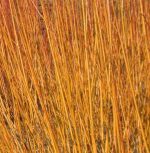
 This deciduous tree, often grown as a shrub, is a member of the willow family, Salicaceae, that also includes aspen, poplar, and cottonwood. It has been cultivated in Europe since ancient Roman times and can be found in wet lands, marshes, streambanks, and on the edges of ponds and lakes. The plants grow up to 70′ tall and have grayish-brown bark that becomes rough and deeply fissured with maturity. The narrowly-lanceolate finely-toothed leaves are up to 4″ long, and are gray-green above, white beneath, and turn yellow in the fall. Male and female catkins appear in different plants in late spring. The male catkins are 2′ long and have tiny flowers with yellowish anthers. The female catkins are shorter than the male and have greenish flowers. The plants are especially value for their golden stems in winter and their ability to grow in wet soil. The best colored stems are achieved by cutting the plants back to 1′ in the winter. Cultivars vary in stem color and growth form. Golden willow is a good choice for hedges, screens, winter garden, rain garden, and erosion control. The genus name, Salix, is the ancient Latin name for one species. The specific epithet, alba, is the Latin word meaning white and refers to the color of the eaf undersides. The varietal name, vitellina, is the Latin word meaning deep yellow (like egg yolk), and refers to the color of the stems.
Type: Deciduous tree often grown as a shrub
Outstanding Feature: Yellow stems in winter; tolerance of wet soil
Form: Vase-shaped if cut back every year
Growth Rate: Rapid
Bloom: Male and female catkins on separate trees in late spring
Size: 6-70′ H x 6-50′ W
Light: Sun to partial shade
Soil: Average, consistently moist to wet, well-drained
Hardiness: Zones 4-9
Care: For best yellow stems cut back to 1′ in late winter; trees are often coppiced or pollarded
Pests and Diseases: Aphids, borers, caterpillars, leaf beetles, sawflies and scale; rust, blights, cankers
Propagation: Softwood cuttings in summer, hardwood cuttings in winter
Outstanding Selections: (have orange-red shoots)
‘Britzensis’
‘Cardinal’,
‘Chermesina’