
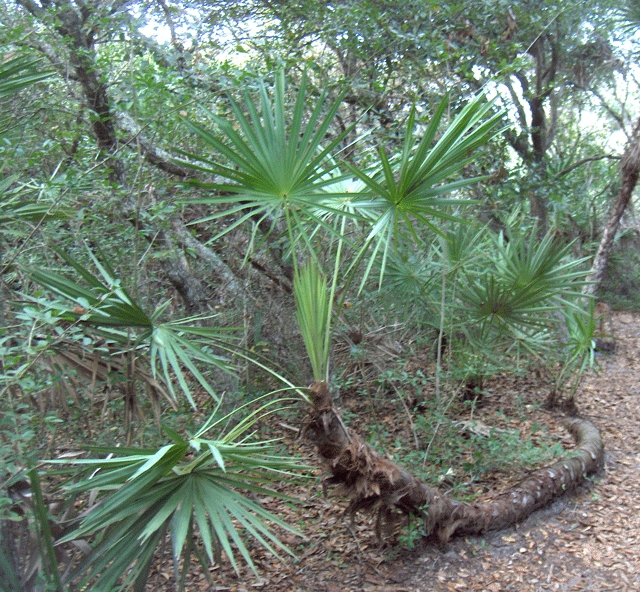
This very long lived evergreen palm is endemic to the subtropical and tropical Southeastern US where it grows in clumps or dense thickets as undergrowth in sandy coastal areas of pine woods and hardwood hammocks. A member of the palm family, Arecaceae, the plant grows 7-10′ tall and has multiple stems that creep along the ground with spine bearing petioles that carry fan-shaped leaves. Each leaf is 39-79″ long and composed of 20 leaflets 20-40″ long. They are light green on inland plants and silvery-white on coastal plants. In spring, compound panicles up to 3′ long carry small, yellow-white, fragrant flowers that are attractive to bees. The fruit is a yellow berry 1/2-1″ long that turns reddish-black when it ripens in the fall and provides food for birds and mammals. The plant provides cover for many animals and is used as a larval food source for some Lepidoptera species. Saw palmetto is tolerant of drought, brief inundations such as can occur in storm surges, salty wind, and salt spray, but palmetto thickets are considered a severe fire hazard. The genus name, Serenoa, honors Serenoa Watson (1826-1892) an American botanist. The specific epithet, palmetto, is the diminutive of the Spanish word palma, meaning small palm.
Type: Evergreen tree that grows as a shrub
Outstanding Features: Flowers, foliage
Form: Rounded
Growth Rate: Slow
Bloom: Panicles of small, yellow-white, fragrant flowers in spring
Size: 5-10′ x 4-10′
Light: Full sun to part shade
Soil: Average to sandy, medium moist to dry, well-drained
Hardiness: Zones 8-11
Care: Low maintenance
Pests and Diseases: None of significance
Propagation: Seed, division of rhizomes
Outstanding Selection:
var. sericea (silver palmetto)
Photo Credit: Homer Edward Price, Wiktionary