
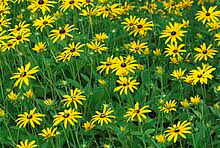
Known as coneflowers and black-eyed-susans, the genus Rudbeckia is native to both damp woodlands and dry prairies of North America. It belongs to the aster family, Asteraceae, that also includes daisy, yarrow and lettuce. Most species are herbaceous perennials but some may be annuals or biennials. They are clump-forming, grow 20″ to 10′ tall, and have erect stems and coarse, deeply lobed hairy leaves that are 2-10″ long. Terminal flowerheads are daisy-like with drooping yellow or orange ray florets surrounding a cone shaped center of greenish or brown to black disc florets. Rudbeckias are easy to grow and do well in sun or light shade in moderately fertile to average, well-drained soil, and are drought and heat resistant once established. Plants are suitable for the border, and in a meadow or prairie garden. The flowers are good in the vase. Photo Credit: Wikipedia
The environmental conditions in the Southwest have resulted in at least twelve species of native coneflowers there but they may be native to other places too. The coneflowers described here are native to at least one of the states in the Southwest.
Orange Coneflower (Rudbeckia fulgida)
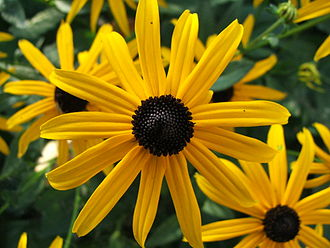
Plants form a basal rosette of leaves that are up to 5″ long, ovate to lanceolate, and evergreen in warm climates. The flowerheads are up to 2.5″ across and have yellow ray florets surrounding a center of brownish purple disc florets. Plants are tolerant of heat, humidity and drought when established and their seeds attract songbirds. Flowers are good in the vase.
Alternate Name/s: Black-eyed-susan
Native Range: Texas and Oklahoma as well as parts of the Southeast, Midwest, Mid-Atlantic and New England.
Habitat: Meadows, pastures, thickets, glades, and open woods
Type: Perennial
Height: 2-3′
Bloom Time: Early summer to fall
Bloom Color: Orange to yellow, purple black
Light: Full sun; tolerates partial shade
Soil: Average, medium moist, well-drained
USDA Hardiness Zones: 3-9
Photo Credit: Jerzy Opioła, Wikipedia
Rough Coneflower (Rudbeckia grandiflora)
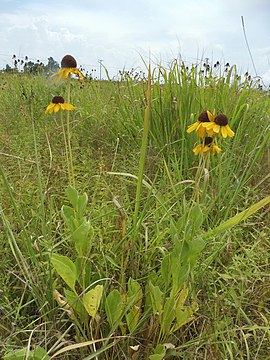
Hairy stems grow from a woody base and carry hairy leaves 2.5-6″ long. Terminal flowerheads appear singly and are 3-4″ across. They are composed of 8-12 yellow drooping rays florets around a brownish-purple center up to 1.25″ tall and attract butterflies and other pollinators. The seeds attract birds and the flowerheads are good in the vase. Plants are tolerant of heat, humidity, and drought.
Alternate Name/s: Tall coneflower, large flower coneflower
Native Range: Texas and Oklahoma as well as places in the Midwest and Southeast
Habitat: Dry open woods, prairies
Type: Perennial
Height: 2.5-5′
Bloom Time: Late summer into fall
Bloom Color: Yellow, brownish purple
Light: Full sun
Soil: Average, medium moist, well-drained
USDA Hardiness Zones: 5-8
Photo Credit: Mason Brock, Wikipedia
Black-Eyed-Susan (Rudbeckia hirta)
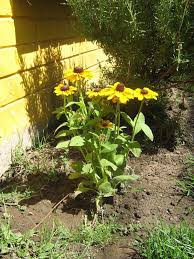
Stiff branched stems arise from a basal rosette of lance-shaped, hairy leaves up to 7″ long. Flowerheads up to 3″ across and have bright yellow to orange-yellow ray florets around a domed, dark chocolate-brown center of disc florets. The flowerheads are attractive to butterflies and other pollinators and the seeds are attractive to birds. The flowering stems are good in the vase.
Alternate Name/s: Brown-eyed susan, yellow ox-eye daisy, brown betty, golden Jerusalem, English bull’s eye, gloriosa daisy
Native Range: Texas, Oklahoma, and New Mexico as well as places on the Pacific coast and in the Rocky Mountain area, Midwest, Southeast, Mid Atlantic, and New England
Habitat: Open areas, prairie, meadows, pastures, plains, savannas, woodlands’ edge
Type: Annual (can be biennial or short-lived perennial depending on the growing conditions)
Height: 24-36″
Bloom Time: Early summer to fall
Bloom Color: Yellow to orange-yellow with dark chocolate brown
Light: Full sun
Soil: Average, medium moist, well-drained
USDA Hardiness Zones: 3-7
Photo Credit: Pandries, Wikipedia
Cutleaf Coneflower (Rudbeckia laciniata)
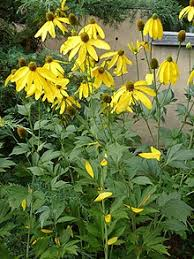
The light green lower leaves are up to 10″” long and may be deeply divided and lobed while upper leaves are smaller and may be lobed. The daisy-like flowerheads are 3-4″ wide and have 8-12 reflexed yellow ray florets surrounding a dome-like center of 150-300 green disc florets that turn brown with maturity. The flowers are attractive to butterflies and other pollinators and the seeds are attractive to birds. Plants tend to spread rapidly and are best used in large landscapes.
Alternate Name/s: Green-headed coneflower, greenhead coneflower, wild goldenglow, sochan, thimbleweed
Native Range: Texas, Oklahoma, New Mexico, and Arizona as well as places in the Rocky Mountain area, Midwest, Southeast, Mid Atlantic, and New England
Habitat: Wet areas in flood plains, along stream banks, and in moist woodlands
Type: Perennial
Height: 2-10′ in the wild, 3-4′ in cultivation
Bloom Time: Mid summer to mid fall
Bloom Color: Yellow with green center
Light: Full sun to partial shade
Soil: Average, medium moist, well-drained
USDA Hardiness Zones: 3-9
Photo Credit: Wikipedia
Great Coneflower (Rudbeckia maxima)
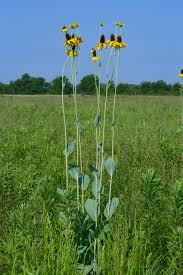
Clumps of silvery-blue leaves up to 24″ long gives rise to sparsely-leaved flower stalks up to 7′ tall. The flowerheads are up to 3″ across and have reflexed yellow ray florets surrounding a dark brown center of disc flower 2-6″ tall. The flowerheads attract butterflies and the seeds attract birds. Flowers are good in both fresh and dried arrangements. Plants tolerate light shade, heat, some drought and a wide range of soils.
Alternate Name/s: Giant coneflower, giant brown-eyed susan, cabbage coneflower, swamp coneflower
Native Range: Texas and Oklahoma as well as places in the Southeast and Midwest
Habitat: Moist sunny sites such as prairies, meadows, pastures,
Type: Perennial
Height: 5-7
Bloom Time: Early to mid summer
Bloom Color: yellow with dark brown center
Light: Full sun
Soil: Average, organically rich, moist, well-drained
USDA Hardiness Zones: 4-9
Photo Credit: Wikipedia
Missouri Coneflower (Rudbeckia missouriensis)
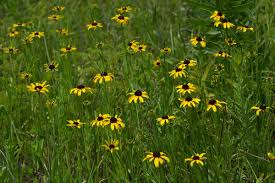
This long-lived perennial forms a basal clump of narrow, green, hairy leaves 2-5″ long. Hairy branched steams carry daisy-like flowerheads with yellow to orange ray florets around a center of dark brown to black disc florets. The flowerheads attract butterflies and other pollinators including bees and are good in the vase. The plants tolerate heat, humidity, and some drought.
Alternate Name/s: Missouri orange coneflower
Native Range: Texas and Oklahoma as well as well as parts of the Southeast and Midwest
Habitat: Limestone glades in the Ozark, rocky prairies
Type: Perennial
Height: 2-3′
Bloom Time: Summer to early fall
Bloom Color: Orange to yellow, dark brown to black enter
Light: Full sun
Soil: Average, dry to medium, well-drained soils
USDA Hardiness Zones: 5-8
Photo Credit: Wikipedia
Bog Coneflower (Rudbeckia scabrifolia)
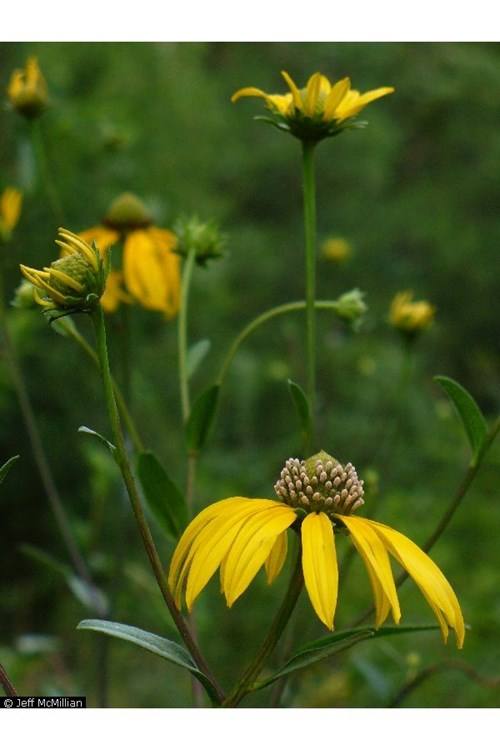
This rare coneflower has dark green, leathery basal leaves that are elliptic to lanceolate and up to 14″ long. Two to fifteen flowerheads appear in branched panicles and consist of 10-15 pale yellow drooping ray florets surrounding a center of 150-400+ green disc florets.
Alternate Name/s: Sabine Coneflower
Native Range: Eastern Texas as well as places in the Southeast
Habitat: Hillside seeps, bogs
Type: Perennial
Height: 3-6′
Bloom Time: Late spring through summer into fall
Bloom Color: Yellow and green
Light: Partial shade
Soil: Average, even moisture
USDA Hardiness Zones: 8-9
Photo Credit: Jeff McMillian
Sweet Coneflower (Rudbeckia subtomentosa)
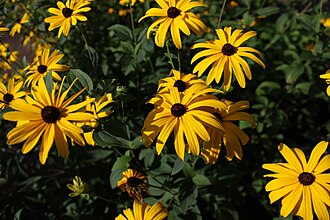
Basal and lower leaves are grayish green, lobed, toothed, up to 8″ long, and hairy on the underside. The branched stems have spreading hairs and carry flower heads 2-3″ across with 10-16 yellow ray florets surrounding a dome of up to 400 dark-purplish-brown disc florets. Flower heads attract bees and other pollinators and plants provide food for butterfly larvae. Tolerant of heat, humidity, and some drought.
Alternate Name/s: Sweet black-eyed susan
Native Range: Arkansas, Louisiana, Mississippi, Tennessee, and Kentucky as well as places in the Midwest and Southwest
Habitat: Wet prairies, woodland edges, along stream banks
Type: Perennial
Height: 3-5
Bloom Time: Mid summer to mid fall
Bloom Color: Yellow with dark brown to purplish center
Light: Full sun to part shade
Soil: Average, medium moist, well-drained
USDA Hardiness Zones: 4-8
Photo Credit: Wikipedia
Black Belt Black Eyed Susan (Rudbeckia terranigrae)
Very little information is available about this plant perhaps because it appears to be rather lanky when many other more attractive Rudbeckia are available for the garden. The leaves are coarse, large, and are clustered mid-stem. The daisy-like flowerheads are carried in loose open clusters and appear to have at least 12 yellow ray florets surrounding a dark center of disc florets. Click here for images.
Alternate Name/s: Blackland coneflower, blackearth coneflower
Native Range: Texas as well as places in the Midwest and Southeast
Habitat: Prairie
Type: Perennial
Height: Relatively tall
Bloom Time: Late summer into fall
Bloom Color: Yellow
Light: Sun
Soil: Average, moderately moist, well-drained; tolerates some dryness (?)
USDA Hardiness Zones: (Guestimate) 7-9
Texas Coneflower (Rudbeckia texana)
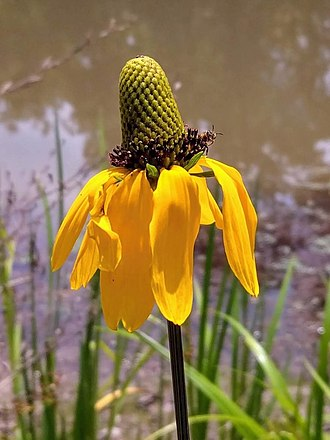
Glossy, dark green basal leaves are 3.5-10″ long and have a leathery texture. Branched stems carry flower heads 3-5″ across. The flower heads may be solitary or in small clusters of 2-5 and consist of reflexed golden ray florets surrounding a tall dome of dark brown disc flowers. Plants attract butterflies and other pollinators. The seeds attract birds.
Alternate Name/s: Shiny coneflower
Native Range: Texas as well as places in the Southeast
Habitat: Coastal prairie
Type: Perennial
Height: 4-6′
Bloom Time: Late spring to fall
Bloom Color: Yellow, brown centers
Light: Full sun, part shade
Soil: Average, medium moist, well-drained
USDA Hardiness Zones: 8-?
Photo Credit: Wikipedia
Brown-eyed Susan (Rudbeckia triloba)
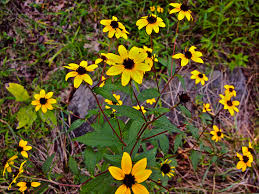
Densely-branched stems are hairy and carry thin, roughly textured, hairy leaves. Basal leaves are 3-6″ long, may be lobed, and may be evergreen in warm climates. Flower heads appear singly or in pairs on the tips of the upper branches. Each flower head is .5-3″ across and has 6-12 golden yellow ray florets surrounding a flat center of purplish disc flowers. Plants attract butterflies and other pollinators including native bees and are tolerant of heat, some drought, and light shade. Seeds are attractive to birds. Flowers are good in the vase.
Alternate Name/s: Thin-leaved coneflower, three-leaved coneflower, branched coneflower
Native Range: Texas and Oklahoma as well as parts of the Rocky Mountain area, Southwest, Midwest, Southeast and Mid-Atlantic
Habitat: Prairies, woodland borders, thickets, rocky slopes, and along streams
Type: Biennial or short-lived perennial
Height: 3-5′
Bloom Time: Mid summer to frost
Bloom Color: Golden yellow with dark brown center
Light: Full sun
Soil: Average, medium moist, well drained
USDA Hardiness Zones: 4-8
Photo Credit: Fritzflohrreynolds, Wikimedia Commons
For the purpose of this article, the Southwest comprises the states of Texas, Oklahoma, New Mexico and Arizona. Other states often associated with the Southwest are included in other geographic areas. The key factor linking these four states is aridity. The area includes high dry plains and true deserts as well as spurs of the Rocky Mountains. Only Texas has a coast on the ocean which brings more precipitation and humidity to east Texas and Oklahoma than elsewhere in the area. In addition to the ocean, the Rio Grande and Colorado Rivers are significant water features in the area. Although temperatures in the mountains can be cool, most of the area experiences hot temperatures for a long period each year.