
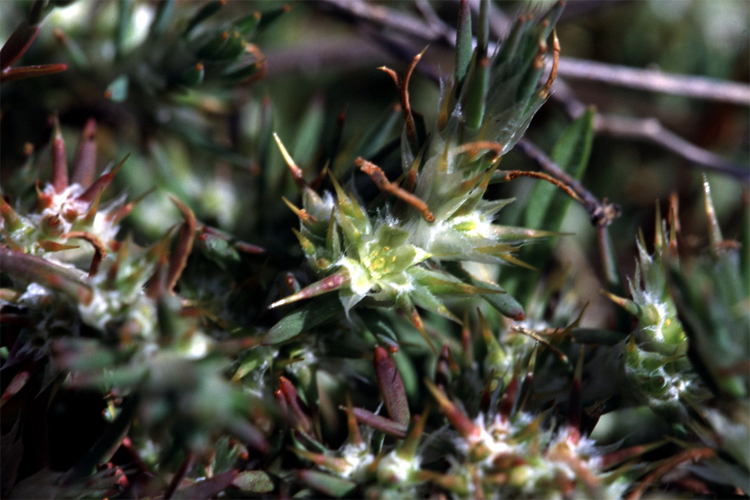
Also called sand mat and tread lightly, this herbaceous perennial is native to beaches along the western coasts of South and North America from Chile to Washington. It is a member of the carnation family, Caryophyllaceae, that also includes pinks, sweet William, and Lychnis. The mat-forming plant grows up to 4″ tall and has a taproot and short branching prostrate stems densely covered with needle-like leaves and long stipules. The lanceolate leaves are 1/2″ long or less, green, often tipped with pink, and have a spine at the tip. The stipules are ovate to lanceolate and are jagged at the end. Both leaves and stipules often remain on the stem even when dead and dried. From mid spring to early summer, 1/8″ wide flowers appear among the leaves and stipules. Each flower has tiny scales for petals and 5 small woolly sepals that give them a white color. The tiny bladder like fruit contains one seed. Sandcarpet is an excellent choice for erosion control on beaches. The genus name, Cardionema, is from the Greek words kardio meaning heart, and nema, meaning thread, referring to the heart shaped anthers slender filaments of the flower. The specific epithet, ramosissimum, is the superlative form of the Latin adjective ramosus and means many branched.
Type: Herbaceous perennial
Bloom: Tiny whitish flowers from mid spring to early summer
Size: 4″ H x 12″ W
Light: Full sun
Soil: Sandy, dry to medium moist, well-drained
Hardiness: Zones 8-10
Care: Low maintenance
Pests and Diseases: None of significance
Propagation: Seed (no treatment necessary)
Companion Plants: Sand verbena, beach evening primrose, beach strawberry
Outstanding Selections: None available
Photo Credit: Gordon-Leppig-Andrea-J.-Pichart Wikipedia
 Karen Meyers