
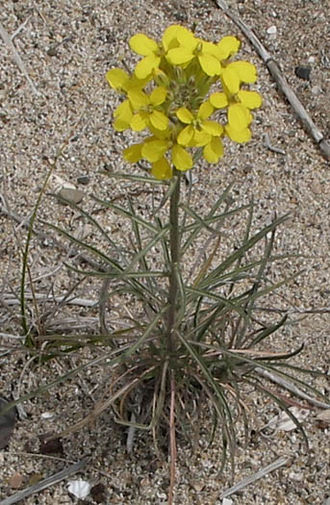
Endemic to the coast of southern California, including the Channel Islands, where it grows on coastal bluffs and sand dunes, this herbaceous perennial or subshrub is a member of the mustard family, Brassicaceae, that also includes cabbage, broccoli, and alyssum. The plant grows up to 24′ tall and has branched, reddish green stems with a woody base, and linear gray leaves that are hairy and up to 6″ long. In spring, racemes of bright yellow to orange-yellow flowers appear. The flowers have 4 sepals and 4 petals, and give way to a linear dry fruit up to 4″ long. Island wallflower is useful for dune stabilization. The genus name, Erysimum, is from the Greek word eryo meaning to drag. The specific epithet, insulare, comes from the Latin word, insula, meaning island and refers to the habitat of one of the subspecies.
Type: Semi-evergreen herbaceous perennial or subshrub
Bloom: Raceme of bright yellow to orange yellow flowers in spring
Size: Up to 24″ H
Light: Full sun
Soil: Sandy, dry to medium moist, well-drained
Hardiness: Zones 8-10
Care: Deadhead to prolong bloom time; prune to maintain shape
Pests and Diseases: None of significance
Propagation: Seed, cuttings
Companion Plants: Sand verbena , beach bur, salt bush
Outstanding Selections:
Erysimum insulare subsp. suffrutescens (most common)
Erysimum insulare subsp. insulare (rare; limited to three of the northern Channel Islands)
Photo Credit: Wikipedia