
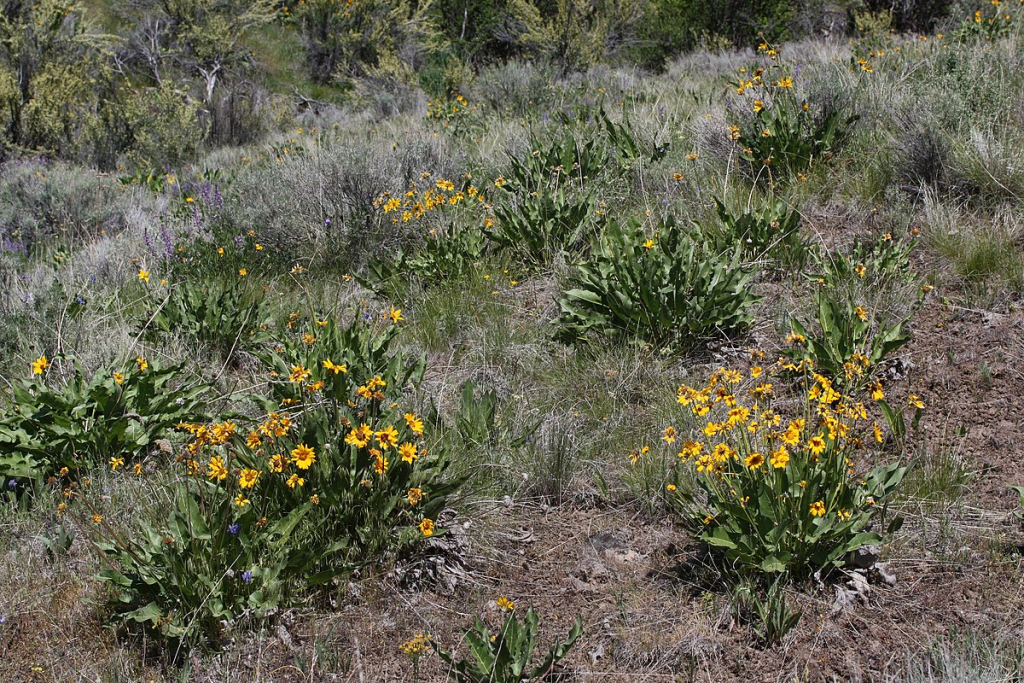
Balsamorhiza is a genus of perennials in the aster family, Asteraceae, that also includes daisies, dandelions and lettuce. Growing from 8-36″ tall, plants typically have fleshy taproots, large basal leaves and erect stems that carry solitary, flowerheads. Each flowerhead is made up of bright yellow ray florets surrounding a center of disc florets. The entire plant is edible and nutritious but not considered tasty. Native Americans used the plants for medicine and food. Wildlife and livestock find the plants palatable. Native to western North America, balsamroot likes full sun and moderately moist to dry, well-drained soil.
The genus name, Balsamorhiza, comes from the Greek words βάλσαμον (bálsamon) meaning balsam, and ρίζα (rhiza) meaning root and refers to the fragrance of the root.
Photo Credit: Walter Siegmund, Wikimedia Commons
Arrowleaf Balsamroot (Balsamorhiza sagittata)
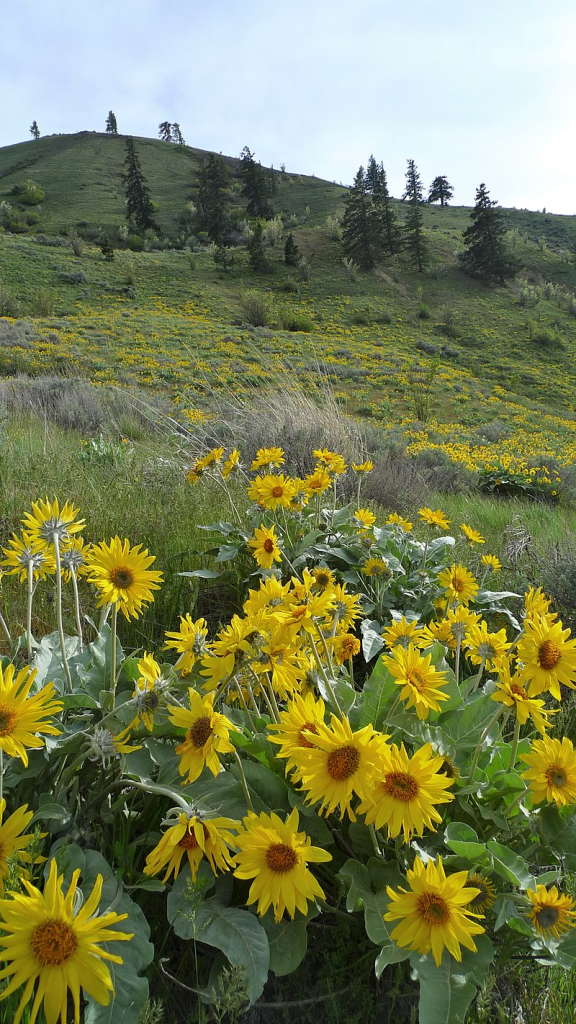
Arrow-shaped basal leaves are carried on petioles 2-18″ long and form silvery gray tufts. Upper stem leaves are linear to elliptic and smaller. All leaves are silvery white to green. Eight to twenty-four hairy, glandular stems arise that are 8 to 24 inches tall and carry 2-3″ wide yellow flower heads from late spring to summer.
Alternate Name/s: Breadroot, Oregon sunflower, spring sunflower
Native Range: South Dakota as well as places in the Rocky Mountain area, Southwest and Pacific Coast.
Habitat: Sandy plains and forest openings at elevations of 4000-8000 ft.
Type: Perennial
Height: up to 31″
Bloom Time: Late spring into summer
Bloom Color: Yellow
Light: Sun to part shade
Soil: Silty to loam, dry to medium moist, well-drained
USDA Hardiness Zones: 4-8
Photo Credit: Thayne Tuason, Wikimedia Commons
The Midwest comprises Illinois, Indiana, Iowa, Kansas, Michigan, Minnesota, Missouri, Nebraska, North Dakota, Ohio, South Dakota, and Wisconsin. The area includes lakes, mountains, and vast fertile plains that are the “bread basket” of the nation. The climate of the Midwest has great variations in temperatures with hot humid temperature averaging 85-95 F in summer and winter temperatures often falling below 0 F. Precipitation comes in the form of both rain and snow and varies from 43.6″/year to 18.8″/year. This climate has resulted in at least one species of balsamroot native to the Midwest, although it is native to other areas too.